1. Product Overview: What a New Energy Charging Pile Actually Is
The term new energy charging pile, also written as EV charging station or charging point, describes the hardware that supplies electric energy to the battery system of an electric vehicle. In the global market the phrase usually refers to the complete outdoor unit: the metal enclosure, the power conversion module, the control board, the metering system, the communication module, and the charging cable with its connector. For a manufacturer that works in sheet metal, the charging pile is not only an electrical product; it is a demanding mechanical product. The enclosure must protect sensitive electronics from rain, dust, heat, cold, vibration, and vandalism, while remaining light enough to install, easy enough to service, and attractive enough to sit beside a supermarket, hotel, or highway service area. As EV sales grow across North America, Europe, Southeast Asia, and the Middle East, charging pile manufacturers are looking for production partners who understand both the electrical and the mechanical side of the product. This report looks at the product, the regional differences, the materials, the production difficulty, the lead time, and the project experience behind a modern charging pile.
AC charging piles, commonly rated at 7 kW, 11 kW, or 22 kW, are the workhorses of destination charging. They are used in apartment buildings, company parking lots, hotels, shopping centers, and workplace car parks, where vehicles stay for several hours. Because the power conversion is mostly handled by the vehicle’s own on-board charger, the pile itself is relatively simple: a robust enclosure, a contactor or relay, a residual current device, a control board, and a Type 1, Type 2, GB/T, or CHAdeMO connector depending on the market. The mechanical challenge is not the internal circuit; it is the enclosure. It must resist weather, provide cable management, allow ventilation without letting water in, and survive years of daily use by drivers who may pull the cable carelessly or leave it lying on wet pavement. Many AC piles use a wall-mounted or pedestal-mounted metal cabinet that is between 300 mm and 500 mm wide and between 600 mm and 1,400 mm tall. The cabinet must be manufactured with tight tolerances so that doors seal correctly, connectors align, and the finished product looks consistent when dozens of units are installed side by side.
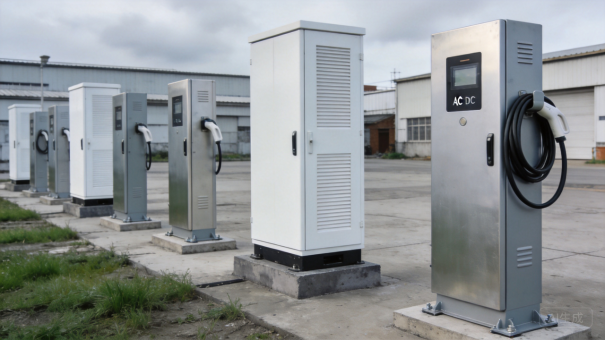
AC and DC charging pile cabinets ready for outdoor installation at a charging equipment factory yard.
DC fast charging piles are a different class of product. Units range from 30 kW and 60 kW for fleet depots to 120 kW, 180 kW, 240 kW, and above 350 kW for highway corridors. Because high-power DC charging creates significant heat, modern fast chargers often use liquid cooling inside the power modules and the cable, which means the enclosure must accommodate coolant loops, pumps, heat exchangers, and more complex wiring. The sheet metal structure must be rigid enough to support heavy power modules, strong enough to survive transport and installation, and precise enough to allow racks, busbars, and connectors to drop into place. A large DC cabinet can weigh 200 kg or more before installation. Any dimensional error in the frame, any weld distortion that changes the door opening, or any hole that is out of position can slow assembly or create a field failure. This is why charging pile brands increasingly source their enclosures from dedicated sheet metal fabricators rather than trying to weld boxes in-house.
The enclosure is often described as the last mechanical component to be designed and the first component a customer sees. It carries the brand color, the screen, the LED status ring, the cable hook, the emergency stop button, and the ventilation grilles. It also carries the weather protection rating. A typical outdoor charging pile is rated IP54 or IP55, meaning it resists dust and water splashes, while some coastal or roadside installations require IP65 or even IP66 with additional sealing. Behind the rating are dozens of small mechanical decisions: where to place the drainage holes, how much to overlap the door edge, what gasket profile to use, how to shield the screen, and how to route cables without creating stress points. All of these decisions happen at the sheet metal drawing stage. A fabricator that can review the design early, point out bend radius problems, suggest stronger corner reinforcements, and confirm that the powder coating will cover sharp edges adds value that is difficult to see in a price comparison.
From a fabrication perspective, the modern charging pile enclosure is usually built from aluminum sheet between 1.5 mm and 3.0 mm thick, with heavier mounting plates and internal brackets. The main body may be formed from one or two large panels, with a separate back panel, door, roof, and base. The roof usually has a slight slope to shed water, the base has cable entry holes or a cable gland plate, and the door has a hidden hinge system plus a lockable handle. Inside, threaded inserts, PEM fasteners, or weld nuts provide mounting points for power modules and control boards. The enclosure also needs ventilation louvers or a fan panel, an EMI shield area around the control compartment, and space for cable routing. When the same design is made in volumes of 500, 2,000, or 10,000 units per year, small improvements in nesting, bend sequence, and fastener count translate directly into lower cost per unit.
For the manufacturer, the product story begins long before the first laser cut. The engineering team must confirm material grade and thickness, flat pattern dimensions, bend allowance, surface finish, and tolerance strategy. The factory must then produce a first article that is checked against the drawing, followed by pilot production that simulates the real production sequence. Only after dimensional, visual, and assembly checks does mass production begin. In our experience at XHX Metal, the difference between a good enclosure and a great enclosure is rarely one big feature. It is the sum of small details: deburred edges that do not cut cable sleeves, mounting holes that align with the module bracket within 0.2 mm, a powder coated surface that passes salt spray testing, and a door that closes with the same feel on the hundredth unit as on the first.
XHX Metal, the English brand of Guangdong Xinghaoxin Technology Co., Ltd., is a privately owned sheet metal company based in Dongguan, Guangdong, with a 2,000-square-meter factory, 28 production machines, and an annual capacity of about 500,000 parts. The company operates two 6 kW fiber laser cutting machines, CNC press brakes, TIG, MIG, and laser welding stations, an automatic deburring line, and CNC machining centers. It holds ISO 9001:2015 certification and has passed CE and SGS verification on its e-commerce channels. For charging pile brands, the company acts as a design-for-manufacturing partner, prototype shop, and volume production plant in one. The sections below explain how regional demand, material selection, production difficulty, and delivery cycles shape a charging pile project.
2. Regional Characteristics: How Local Markets Shape Charger Design
Charging infrastructure is not a single global product. A pile that works well in California may fail its first summer in Singapore, and a design that passes European certification may need significant changes before it can be sold in North America. Regional characteristics affect not only the connector and the power standard, but also the enclosure materials, the coating system, the ventilation strategy, and the installation method. Any manufacturer planning to export charging piles, or to supply enclosures to brands that export, should understand these differences before finalizing the sheet metal design.
North America is defined by the 120/240 V split-phase system for AC charging and by CCS1 and NACS connectors for DC charging. Certification matters more than almost anywhere else: products need UL or ETL listing, and the National Electrical Code (NEC) imposes requirements for grounding, conduit, and accessible disconnects. Climate varies enormously, from cold Canadian winters where ice can form on connectors and door seals, to hot Texas summers where electronics need effective heat management. Enclosures for this market tend to be larger, with more internal space for service access, and they often use heavier-gauge metal because installers and inspectors expect a robust feel. Cold-weather designs may add heater pads, insulated door seals, and cable management that prevents the cable from freezing to the ground. Coastal locations such as Florida, California, and the Gulf states create salt-air exposure that pushes designers toward aluminum with high-quality powder coating, or stainless steel for critical hardware.
Europe is one of the most mature charging markets, with Type 2 connectors standard for AC and CCS2 for DC. Products must carry CE marking and comply with IEC 61851, and many countries add national requirements such as MID-approved metering, RFID access, and specific grid connection rules. Space is the defining constraint in European cities: charging piles are installed in narrow sidewalks, old building courtyards, and compact parking garages, so enclosures must be slim, tidy, and visually quiet. Designers often choose wall-mounted AC units with a low profile, or pedestal units that take up less than half a square meter. Because rain, humidity, and temperature swings are common, IP54 or IP55 is the practical baseline, and the coating must resist the salty air of coastal cities such as Barcelona, Lisbon, and Athens. European buyers also care about serviceability; doors, modules, and connectors are designed to be replaced quickly by local technicians.
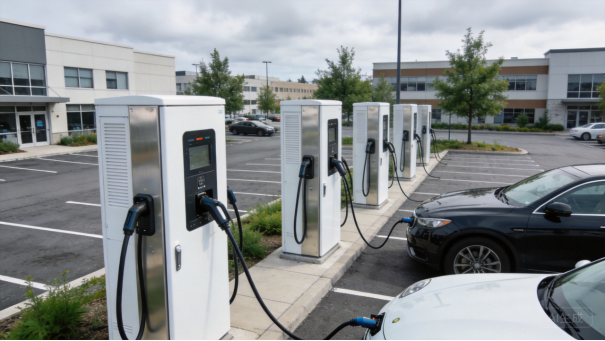
Charging piles installed beside a commercial parking lot in everyday urban conditions.
In Southeast Asia and India, the biggest enemies of charging hardware are heat, humidity, heavy rain, and pollution. Temperatures routinely exceed 35 degrees Celsius, and the monsoon season brings water that can find its way into poorly designed seams. Many sites are outdoors with no canopy, so the enclosure receives direct sun during the day and high humidity at night, which stresses seals and coatings. Cost is also more sensitive, and grid power can be unstable, so the enclosure may need to accommodate larger components or additional protection. Aluminum is attractive here because it resists corrosion and reduces the weight that installers must handle, but the coating system must be robust: a thick powder coat with proper pretreatment, or an anodized finish for parts that will be touched frequently. Dust is another regional factor; ventilation filters must be accessible for cleaning, and louver designs should keep out wind-driven rain during storms.
The Gulf states combine extreme heat, sand, and intense sunlight. Surface temperatures on a metal enclosure can exceed 70 degrees Celsius in summer, so heat management is critical: sun shields, double-wall construction, shade structures, and cooling fans are common. Sand and dust require filtration and positive sealing, while salt from the Gulf air affects exposed metal. The market is expanding quickly, especially in the United Arab Emirates, Saudi Arabia, and Qatar, where governments are building large EV corridors and fleet projects. For the sheet metal manufacturer, the regional lesson is that coating quality and seal design are not optional upgrades; they are the product. Aluminum 5052 or 6061 with a thick weather-resistant powder coat, stainless steel fasteners, and high-quality EPDM or silicone gaskets are typical choices.
Australia has one of the highest home- and solar-charging adoption rates in the world, and many sites are coastal, so salt corrosion is a constant concern. The country also has strict electrical standards and a growing fast-charging network along highway corridors between major cities. Latin America is more price-sensitive and fragmented, with a mix of Chinese, European, and local brands. Projects there often favor standard designs with lower specification accessories, simpler mounting systems, and easy maintenance. In both regions, shipment distance and port logistics matter, so enclosures that nest well and ship flat, with doors and brackets packed separately, reduce freight cost and damage risk.
The practical conclusion is that a good enclosure design should start with a region profile, not with a generic drawing. The same aluminum cabinet can be produced in several variants: a coastal version with 316 stainless hardware and double powder coating, a tropical version with larger air filters and drainage, a cold-climate version with heater provisions and insulated seals, and a standard version for protected indoor or covered sites. XHX Metal regularly works from customer drawings and marks up these regional variants during the DFM review. This early discussion saves money because changing a bend, a gasket groove, or a fastener type at the drawing stage costs almost nothing, while changing it after tooling and painting costs a great deal.
Standardization is another regional factor. In China, GB/T connectors and the national charging standard have created a huge domestic market with low-cost, high-volume production; in Europe, the Type 2 and CCS2 ecosystem is supported by interoperable roaming networks; in North America, the transition from CCS1 to NACS is still reshaping hardware, so enclosures must be designed with swappable connector plates and flexible cable routing. These differences affect the sheet metal part directly: the cutout for the connector, the position of the cable hook, the space for the control board, and even the direction of the door hinge must be confirmed against the target market before tooling is made.
Grid and installation conditions also differ. European projects often require the pile to be installed on public sidewalks with a minimal footprint, while North American sites tend to have more space but stricter electrical inspection. In dense Asian cities, installers may carry the pile up stairs or mount it on thin walls, which favors lighter aluminum and smaller wall-mounted formats. In Middle Eastern and Australian projects, ground mounting with a concrete base is common, which changes the base plate design and the anchor pattern. A good DFM review should always ask where the pile will be installed, because the answer changes dozens of mechanical details, from the hinge side to the cable entry position.
3. Material Characteristics: Selecting the Right Metal for Outdoor Charging Hardware
The material characteristics of a charging pile enclosure determine its weight, corrosion resistance, thermal behavior, manufacturing cost, and long-term appearance. The most common choices in the industry are aluminum alloy, stainless steel, and galvanized or pre-coated steel. Each has a clear role, and the correct choice depends on the target market, the volume, the finishing line available, and the budget. This section explains the material behavior that matters most for charging hardware and how a sheet metal partner should help select it.
Aluminum alloy is the most popular choice for modern charging piles because it offers an excellent balance of weight, corrosion resistance, formability, and thermal performance. Alloys such as 5052, 6061, and 6063 are common in sheet metal work. 5052 is easy to form and weld, with good corrosion resistance, making it a practical choice for large cabinet panels. 6061 provides higher strength, better machining characteristics, and good anodizing response, so it is often used for mounting plates, internal brackets, and components that carry load. 6063 is common for extrusions used as mounting rails, door frames, and heat sinks. Aluminum has roughly one-third the density of steel, so a full aluminum enclosure can be 40 to 60 percent lighter than a steel equivalent, which reduces freight cost, makes installation easier, and allows wall-mounted piles on lighter structures. It also conducts heat well, helping the enclosure act as a partial heat sink for power modules.
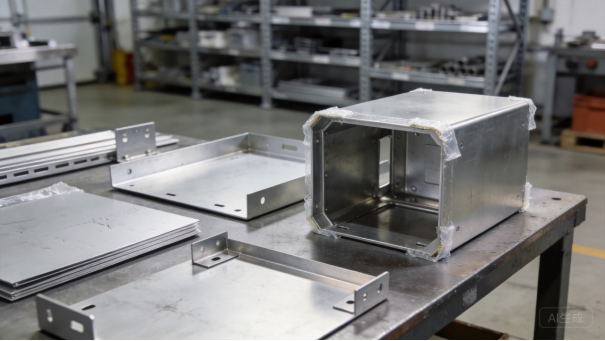
Aluminum sheet, brackets, and formed panels waiting for assembly in a sheet metal workshop.
Stainless steel is the material of choice for the harshest environments and for parts that will be visible for decades. Grades 304 and 316 both form a self-healing chromium oxide layer that resists rust, moisture, and chemicals, and 316 adds molybdenum for better resistance to chloride, which matters in coastal and de-icing-salt environments. Stainless steel is significantly heavier and more expensive than aluminum, and it is harder to cut and bend, but it is extremely durable. For charging piles, stainless steel is often used selectively rather than for the whole cabinet: mounting bases, door handles, hinge pins, cable hooks, and fasteners, with aluminum panels for the main body. In marine environments, a small change such as upgrading the fasteners from zinc-plated steel to 304 or 316 stainless can prevent the most common field complaint.
Galvanized steel and cold rolled steel remain economical options for indoor, covered, or budget-oriented projects. Galvanized steel carries a zinc coating that protects against moderate outdoor exposure, and it is strong and inexpensive. However, the zinc layer can crack or flake during intense bending, and the spangled surface is not as uniform as a painted finish, so most manufacturers use it as a substrate that is then powder coated. Cold rolled steel has a smooth, precise surface and excellent formability, but it has almost no corrosion resistance on its own; it must be protected by a complete pretreatment and painting process. For charging piles that will live outdoors, cold rolled steel should be avoided unless the finishing system is excellent, because a single scratch in the coating can become a rust stain within months.
Surface treatment is where material characteristics become product performance. Powder coating is the standard choice for outdoor enclosures because it provides a thick, tough, uniform layer that resists scratching, fading, and corrosion. The process starts with cleaning and chemical pretreatment, usually zinc phosphate or chrome-free conversion coating for aluminum, followed by an electrostatic application of powder and oven curing. For aluminum, anodizing is an alternative that creates a hard oxide layer integrated into the metal surface; it is very durable and maintenance-friendly, though it offers less color variety than powder coating. Some designs also use conductive paint or EMI shielding coatings on internal surfaces, especially around the control and communication module compartment, to reduce electromagnetic interference in a product that carries both high-power and low-signal circuits.
Cost is a second dimension of material characteristics. Comparing metals by price per kilogram is misleading because density differs so much. A cubic meter of stainless steel weighs far more than the same volume of aluminum; even when aluminum is more expensive per kilogram, it can still cost less per unit of volume. For an enclosure, the relevant comparison is cost per finished part, which includes material, cutting, bending, welding, finishing, and freight. Aluminum is usually the most economical choice for a lightweight outdoor cabinet, stainless steel is justified where corrosion or mechanical abuse is extreme, and galvanized steel is competitive when volume is high and weight is not a concern. A good fabricator can provide this finished-part cost comparison before the design is frozen.
Beyond the metal itself, material characteristics include the small components that make the enclosure weatherproof. EPDM or silicone gaskets must compress without taking a permanent set, so the flange design should provide a controlled gap. Aluminum panels may need a conductive gasket or spring finger around the door to maintain shielding continuity. Fasteners should be stainless steel or aluminum with proper sealing washers to avoid galvanic corrosion between dissimilar metals. Internal brackets should avoid sharp edges near cables, and cable glands should be matched to the wall thickness of the base plate. These details are often specified by the charging pile brand, but a fabricator with material experience can flag conflicts, such as a gasket groove depth that exceeds the bend tolerance or a fastener that reacts poorly with the chosen coating.
In summary, material selection for a charging pile should be treated as a system decision. Start with the target region and expected service life, then choose a substrate, a finish, and a hardware specification that work together. For most global projects, a 5052 or 6061 aluminum body with a chrome-free pretreatment, a thick outdoor powder coat, stainless steel external hardware, and EPDM gaskets is a proven formula. For coastal or chemical-heavy sites, upgrade to 316 stainless fasteners and consider a marine-grade coating. For high-volume indoor products, a powder coated galvanized steel enclosure can cut cost without sacrificing quality. XHX Metal keeps all of these material routes available and documents the mill certificates and coating test results for every batch.
When a project is planned for multiple regions, the standard practice is to keep one body design and vary the finish and hardware options, so the same bending and welding tools can serve several markets. This reduces tooling investment, shortens the production schedule, and makes the supply chain easier to manage when the customer later adds a second region.
4. Production Difficulty: Precision, Heat, and Tolerance Control
Producing a charging pile enclosure is more difficult than producing a simple box, because the product combines large formed panels, tight dimensional requirements, welded joints, complex cutouts, and a finish that must survive outdoor conditions. The production difficulty is not concentrated in any single step; it is distributed across the whole process. Each step has failure modes that only become visible later, in assembly or in the field. This section walks through the main production stages and explains what makes each one difficult.
Laser cutting is usually the first step. For a 6 kW fiber laser, cutting aluminum sheet between 1.5 mm and 3.0 mm is routine, and XHX Metal’s machines hold positioning accuracy of plus or minus 0.01 mm on the machine axis. The difficulty is in the details: nesting parts to minimize scrap, controlling cut taper on thicker material, deburring small holes, and protecting the sheet surface from scratches. The design must also account for kerf width and the order of cutting features, especially when a panel has dozens of holes, louvers, and mounting slots. If the drawing does not specify tolerances realistically, the laser can produce a part that is dimensionally perfect but impossible to assemble because the bend sequence conflicts with the cut features.
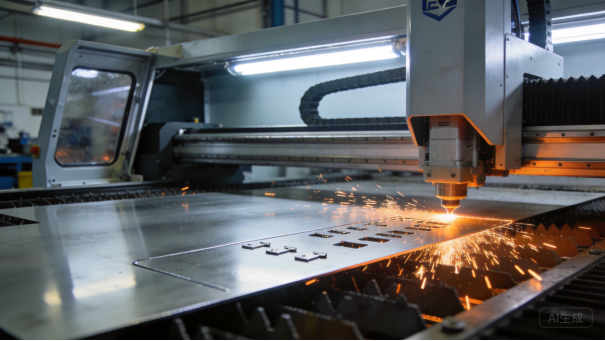
Fiber laser cutting of aluminum sheet for charging pile enclosure panels.
Bending is where flat panels become 3D enclosures, and it is the step where most dimensional problems originate. A CNC press brake uses a punch and die to create bends, but the finished bend angle depends on material thickness, grain direction, tooling, springback, and the previous operations. Aluminum has a different springback characteristic than steel, so the bending program must be adjusted for the specific alloy and batch. The bend radius must be larger than the material thickness for aluminum to avoid cracking; sharp internal corners may require a relief slot or a redesign. On a large enclosure, a small error in bend angle can shift a mounting hole by several millimeters over the width of the panel, so the press brake operator must use angle measurement and correction, and the QA team must check the first article thoroughly.
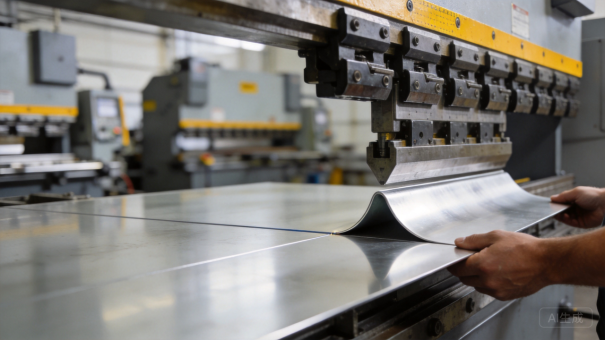
CNC press brake forming an aluminum enclosure panel with a controlled bend radius.
Welding is the most demanding step for aluminum enclosures. TIG welding is preferred for clean, strong joints, but aluminum conducts heat quickly and has a low melting point, which makes distortion and burn-through common. The key is control: clean the oxide layer before welding, clamp the parts to prevent movement, use the correct filler wire and shielding gas, and sequence the welds so heat does not accumulate in one corner. A long cabinet seam can pull the panel out of flatness by several millimeters if welded carelessly, and that distortion will then fight the door seal and the coating. Some manufacturers use laser welding for precision joints and MIG welding for structural parts, and XHX Metal maintains all three processes so the right method can be chosen for each joint.
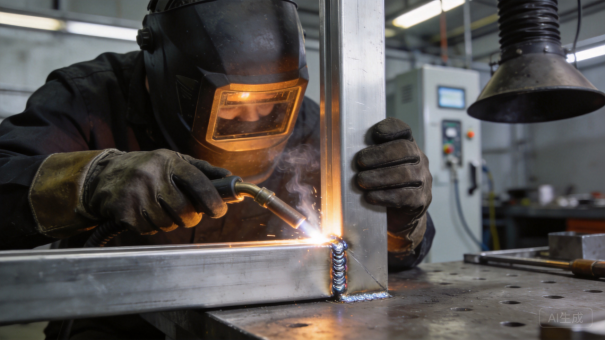
TIG welding an aluminum charging pile enclosure frame in a fabrication cell.
Deburring and surface preparation are easy to underestimate. Laser-cut edges can be sharp enough to cut cable sleeves and installer gloves; punched holes may have burrs that damage insulation; and welded seams need grinding so the powder coating does not build up unevenly. An automatic deburring line removes most of the risk, but complex parts still need hand finishing. The goal is a part that is safe to handle, safe for the wires inside, and smooth enough for a uniform coating. Any defect at this stage tends to reappear later: a sharp edge can cause a warranty claim months after installation, and a rough weld can create a coating failure that looks like a quality problem in the finished pile.
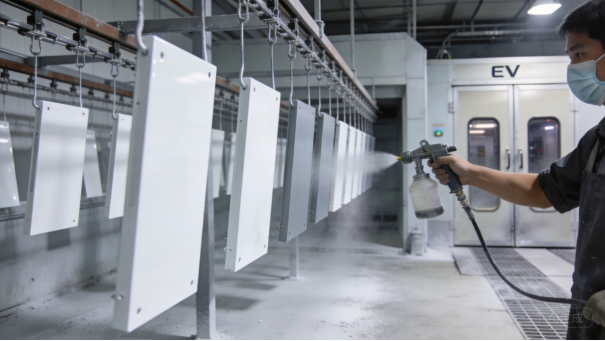
Powder coated charging pile panels moving through the finishing line.
Assembly adds electrical and mechanical complexity. The fabricated cabinet must accept power modules, control boards, busbars, cable looms, fans, and door components, so the frame tolerances have to be consistent from unit to unit. If threaded inserts are installed after powder coating, they must be masked or cleaned; if weld nuts are used, their positions must be checked. The assembly stage is also where grounding continuity matters. A charging pile is a high-power product, so every door, panel, and structural member must be connected to a common ground path. Some designs use a conductive coating on mating surfaces, others use dedicated ground straps; the sheet metal partner must respect the drawings and not introduce paint or anodizing that blocks electrical continuity.
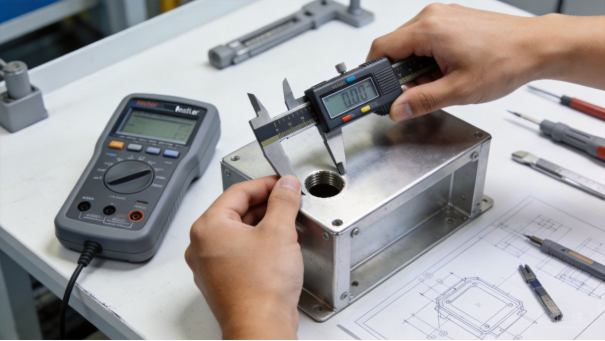
Dimensional and electrical inspection of a finished enclosure before shipment.
Testing turns a good-looking cabinet into a certified product. Before shipping, enclosures are typically checked for dimensions, door alignment, gasket compression, and surface quality, while the assembled pile is tested for insulation resistance, grounding continuity, hipot withstand voltage, and earth fault protection. For the sheet metal part, the most relevant tests are salt spray, humidity, and water ingress. A 72-hour neutral salt spray test is common for coating verification, and a cabinet must pass the IP water test with its doors closed and cables fitted. XHX Metal performs dimensional inspection, first article inspection, and full batch inspection on visible and functional features, and documents the results so the customer can trace a batch back to the material certificate and production records.
XHX Metal’s production setup is designed around this difficulty. The factory has two 6 kW fiber laser cutting machines so one can continue while the other is maintained; multiple CNC press brakes; TIG, MIG, and laser welding stations; an automatic deburring line; CNC machining centers; and a dedicated inspection area. The team follows ISO 9001:2015 procedures, and every order goes through a kickoff meeting that identifies critical dimensions, special finishes, and inspection points. This does not make charging pile enclosures easy; it makes them controllable, and control is what the customer is actually buying when the production difficulty is high.
Fixturing and process documentation are the hidden part of production difficulty. A charging pile cabinet is assembled from many panels, and without a welding fixture the frame can drift from square even when every part is cut correctly. XHX Metal uses simple check fixtures and written work instructions so that the first unit of the day and the last unit of the day are assembled the same way. This may sound like an obvious practice, but in small workshops it is often skipped, and the result is a batch of enclosures that look identical in photos yet fit differently on the assembly line.
5. Lead Time: From Engineering Drawings to Shipped Charging Piles
Lead time is often the first question a charging pile brand asks, and it is also the most misunderstood. A realistic schedule depends on the product maturity, the material availability, the finishing process, the test requirements, and the shipping mode. For a new design, the total time from approved drawings to delivery usually falls between four and eight weeks for samples plus production, while a repeat order of an established design can ship in two to five weeks. This section explains each part of the cycle so buyers can plan realistically and avoid expensive surprises.
The cycle starts with design review and quoting. When XHX Metal receives a 3D model and drawing, the engineering team checks material, thickness, bend radii, hole sizes, tolerances, and finish specifications, and highlights anything that will be difficult to produce. This DFM review usually takes one to three working days and can be done during the quotation process. A clear drawing with a defined finish, a defined inspection standard, and a defined packaging method produces a faster and more accurate quote. If the customer can approve a production intent drawing at this stage, the later schedule is much more stable.
Material procurement is the first real calendar item. Aluminum sheet, stainless steel, and pre-coated steel are usually available from local suppliers in standard sizes, so procurement takes one to three working days for common grades and thicknesses. Special alloys, anodized sheet, or materials with mill certificates for specific lots may take longer. Because the price of aluminum changes with the market, most projects are quoted with a material validity period, and the customer should lock the material specification at the same time as the order to avoid a mid-project change.
Prototyping and tooling come next. For a completely new enclosure, XHX Metal typically produces a first article within one to two weeks after material arrives. The first article includes laser-cut and formed panels, welded and deburred components, and in many cases a trial powder coat on one part, so the customer can verify dimensions, appearance, and assembly fit. If the design requires dedicated bending tooling, a special forming die, or a jig for welding, tooling design and machining can add a few days to two weeks. The customer’s approval of the first article is the green light for production, and any changes requested at this stage extend the timeline accordingly.
Mass production runs in batches that are sized to the order. For quantities of 50 to 500 units, production usually takes one to three weeks depending on the number of processes and the finishing capacity. The factory sequences cutting, bending, welding, deburring, and surface treatment so that panels flow through each stage without waiting. Because XHX has two laser cutters, a failed maintenance event does not stop the whole order, which is a real advantage for time-sensitive projects. Batch production also allows the QA team to check the first part of each shift and the last part of each shift, catching drift before it becomes a whole batch problem.
Surface treatment and assembly are often the bottleneck. Powder coating requires cleaning, pretreatment, spraying, and curing, and each step takes time; a large enclosure may spend more time in the finishing line than in cutting and bending combined. If the design includes conductive coating on internal surfaces, masking work adds more hours. After coating, the parts must cool, be inspected, and then be assembled with fasteners, gaskets, and accessories. Some customers prefer to receive raw fabricated parts and do their own electrical assembly; others ask XHX to install inserts, fit gaskets, and even build complete enclosures ready for their electronics. The chosen scope directly changes the lead time.
Quality control and packaging happen in the final days. XHX performs a full inspection on visible features and functional dimensions, as well as first article inspection on every new batch. The inspection time is short, but the packaging design matters: aluminum enclosures are easily dented, and a powder coated surface is easily scratched, so edge protectors, corner blocks, and film are essential. For charging piles, packaging should also protect screen cutouts and door handles. Sea freight pallets are usually consolidated so the customer can receive the full order without damage; the packing list, material certificates, and inspection reports are prepared at the same time.
Shipping is the final variable. From Dongguan, air freight to North America or Europe takes about three to seven days once the cargo is ready, while sea freight to a major port takes three to five weeks, plus customs and inland delivery. Many customers plan the production schedule so that sea freight makes sense; for urgent replacement parts or a new product launch, air freight may be worth the cost. XHX Metal can quote FOB, CIF, DDP, and door-to-door options, and will advise which method best fits the project value and deadline.
The company’s on-time delivery record is 93.1 percent on the Alibaba international platform, which reflects the scheduling discipline used on every order. The practical advice for buyers is simple: freeze the design, confirm the finish, approve the first article quickly, and order spare material or spare parts at the same time as the main order. A small extra batch of panels or a set of doors costs little when produced with the main run, but it is expensive to reorder later. With clear inputs, a new charging pile enclosure project can go from drawing to sample in two to three weeks, and from approved sample to delivered production in three to five weeks.
Communications during production are as important as the schedule itself. XHX Metal sends batch photos, inspection reports, and a weekly production update for every charging pile order, so the customer can track the project without waiting for a delivery day surprise. If a material delay or a finishing issue appears, the company proposes a recovery plan in the same message. This transparency is why repeat customers usually place the next order before the previous one is finished.
Tooling ownership should also be agreed early. Some customers want the bending tools and fixtures stored at the factory for future orders, while others ask for them to be shipped with the final batch. XHX Metal documents the tool list and its ownership condition in the order confirmation, so there is no dispute when a design changes or a reorder arrives.
6. Past Cases: Charging Enclosure Projects We Have Built
No news report about charging pile manufacturing is complete without project examples. Because customer confidentiality is part of XHX Metal’s service, the cases below are described without brand names, but they are representative of real projects produced by the company in the last three years. They show how regional requirements, material choices, production difficulty, and lead time come together in practice.
Case 1: DC fast charger enclosures for a North American fleet operator. A fleet management company was rolling out electric delivery vans and needed 120 kW DC chargers at three depots. The original supplier delivered enclosures that warped during welding, making it difficult to fit the power modules and door seals. XHX Metal redesigned the frame with additional stiffening, specified 5052 aluminum with 2.5 mm thickness on large panels, and changed the welding sequence so heat was distributed evenly. The first article was approved in nine working days, and 240 enclosures were delivered over four weeks. The customer reported that assembly time per charger dropped by about 30 percent because the modules slotted in without rework.
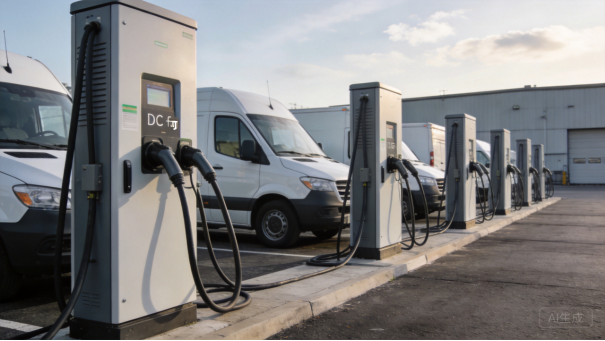
DC fast charging piles installed at a commercial fleet depot.
Case 2: Urban AC charging network for Southeast Asia. A utility-backed operator in a tropical city needed 1,000 wall-mounted AC charging piles for apartment blocks and public parking. The key requirements were humidity resistance, low cost, and easy maintenance. XHX Metal supplied the enclosures in 1.5 mm 5052 aluminum with a chromate-free pretreatment and a textured outdoor powder coat, plus stainless steel fasteners and a simplified cable management system. The design was adjusted to increase drainage and allow the fan filter to be removed from the front. The pilot batch of 50 units passed a 200-hour humidity test, and the full order was shipped by sea in three batches over nine weeks.
Case 3: Coastal fast charging cabinets for Europe. A charging point operator planned 60 kW and 180 kW cabinets for highway service areas near the Mediterranean. Salt air and wind-driven rain were the main threats, so XHX Metal specified 316 stainless steel for external hardware, a thicker powder coat with two-layer protection on the base, and EPDM gaskets with a deeper compression groove. The cabinets also received an internal conductive coating around the control compartment. Because the design was already mature, production took only two weeks for the first 120 units, and the first installation sites passed their electrical inspection with no water ingress findings.
Case 4: OEM enclosure supply for a Middle East charging brand. A brand launching in the Gulf region needed a complete enclosure program: a 240 kW DC cabinet, a 22 kW AC pedestal, and a wall-mounted unit, all in a consistent family look. XHX Metal produced the DFM review, prototypes, and a small pilot run, then scaled to monthly batches. The family design reduced the number of bend tools and standardized the gasket and fastener kit across the three products, which cut the unit cost after the sixth month. The customer now receives monthly deliveries by sea plus a small air freight buffer stock, so installation teams in Dubai and Riyadh never wait for enclosures.
Across these projects, the lessons are consistent. First, early DFM review prevents the majority of assembly problems. Second, material and finish choices must match the region rather than the lowest price. Third, welding and bending consistency is what makes a design repeatable at volume. Fourth, a clear first article approval and a frozen drawing are the best ways to protect the schedule. Fifth, the customer relationship matters: the same team that answers the DFM questions is the team that delivers the parts, and a private company can make decisions quickly without layers of approval.
Each case also had a common starting point: an engineering review before the first quote, a sample approved against a written checklist, and a production plan with inspection gates. The names and locations are kept confidential, but the technical details reflect the work done in the factory and the lessons learned on the shop floor.
Case 5: AC pedestal program for a European parking group. A parking operator was upgrading 60 underground and multi-storey car parks with 300 AC charging points. The constraints were unusual: limited space, strict building authority rules on ventilation and fire resistance, and a requirement that the pile look neutral in a heritage building. XHX Metal developed a compact pedestal enclosure in 2.0 mm 5052 aluminum, with a reduced louver area, a sealed cable gland plate, and a quick-release door hinge that allowed one technician to service the unit in under ten minutes. The first 30 units were delivered in three weeks, and the parking group approved the design after a four-week trial. Because the same design was used across all 60 sites, spare parts were interchangeable, which reduced the operator’s maintenance inventory. The program continued with monthly orders through the following two years.
Case 6: Fast charger cabinet upgrade for an Australian highway network. An Australian energy company wanted to increase its highway fast charging capacity from 60 kW to 180 kW without replacing the existing concrete foundations. The new cabinets had to fit the old footprint, use the existing cable ducts, and survive coastal salt air. XHX Metal redesigned the enclosure with a double-wall roof, sealed base, and a removable service panel, while keeping the anchor pattern unchanged. After two rounds of first article samples, production of 150 cabinets was completed in five weeks, and the first sites were energized on schedule. The redesigned cabinet also reduced installation labor because the service panel could be opened without removing the door, and its lighter aluminum body made it possible to lift the unit with two installers instead of a crane.
These examples also show how much can be improved after the first production run. In the fleet project, the second order included a revised cable hook position that reduced strain on the connector; in the Southeast Asia project, the third batch changed the fan location after a heat study; in the coastal project, the gasket was upgraded after the first winter inspection. A fabricator that keeps production records and listens to field feedback can turn small complaints into design improvements that benefit every future batch. That is the difference between a supplier and a manufacturing partner.
7. Summary: What to Prepare Before Starting a Charging Pile Project
The charging pile is becoming the most visible piece of EV infrastructure, and behind every reliable pile there is a carefully manufactured sheet metal enclosure. The product story, regional differences, material behavior, production difficulty, and lead time all point to the same conclusion: the enclosure should be designed and sourced with the same seriousness as the power electronics inside it.
For a buyer preparing to start a project, the engineering package matters. A complete set of inputs should include the 3D model and 2D drawing, material grade and thickness, bend radius and tolerance callouts, surface finish and color, gasket and fastener specification, mounting and cable entry locations, screen and connector cutouts, packaging requirements, and target volume. Even a short DFM checklist, answered in one email, can save a week of back-and-forth later.
The commercial package is equally important. Confirm the delivery incoterm, the inspection standard, the payment schedule, the material validity period, and the penalty or reschedule rules for design changes. Ask for a first article schedule, a production capacity statement, and a list of certifications. ISO 9001:2015, CE, and SGS verification are useful signals, but the practical proof is how quickly the supplier answers a drawing question and how carefully it documents a batch.
XHX Metal is a good match for this kind of project because it is a privately owned company with production control in one place. The owner and engineering team can approve tooling changes, discuss material substitutions, and agree on a realistic delivery date without passing decisions through a distant headquarters. The factory has two 6 kW fiber laser cutters, CNC bending and welding capability, an automatic deburring line, and a 500,000-part annual capacity, which is enough for mid-volume charging pile brands and flexible enough for prototype runs.
If you are developing a new charging pile or improving an existing one, the fastest way to start is to send the drawings and ask for a DFM review and quotation. XHX Metal can confirm the material route, the finish system, the production difficulty, and the realistic lead time within a few working days. Contact Barry at +86 13244963694 or sales01@xinghaoxin.com, or visit https://www.xhxmetal.com. The factory is located at No. 42 Changtang Avenue, Yantian, Chang’an Town, Dongguan, Guangdong, China.
EV charging is still a young industry, and the hardware will keep changing: higher power levels, liquid cooling, smarter metering, and new connector standards. What will not change is the need for an enclosure that is flat, square, sealed, and finished well. A manufacturer that controls its sheet metal process can make those improvements fast, and that is the practical advantage of working with a company like XHX Metal.
The decision criteria are simple: compare finished-part cost, not material price per kilogram; test the coating before freezing the design; check the first article before mass production; and plan the freight before signing the order. Following these steps will help any team turn a charging pile concept into a product that survives its environment, passes certification, and stays in service for years.
File format is another small detail that saves time. STEP files work well for geometry reviews, PDF drawings with GD&T are the basis for inspection, and DXF or DWG flat patterns help the factory prepare laser programs. XHX Metal asks for the drawing revision number and the finish specification in writing, and logs every change in the project file. This may feel administrative, but when a field issue appears six months later, the ability to identify exactly which version was shipped is worth more than the time it took to record it.
Testing and certification should be discussed before production, not after. If the customer needs a specific coating test, a flammability rating, or a corrosion test report, the material and pretreatment must be selected at the quotation stage. XHX Metal can prepare material certificates, coating thickness records, and first article reports, and works with the customer’s testing schedule so that samples are available early. Waiting until the end of production to discover that a test cannot be passed is the most expensive mistake in any enclosure project.
The relationship model also matters. Some buyers treat the factory as a transaction: send a drawing, wait for parts, and complain when they arrive late. Others share their roadmap and allow the factory to suggest improvements before the design is frozen. XHX Metal works best with the second type. Because the company is privately owned, a decision can be made in hours, not weeks: the engineering manager can discuss a bend change in the morning and the shop can test it in the afternoon.
The company also keeps a small inventory of common aluminum and steel sheets, so urgent charging pile orders can start cutting the same week the drawing is approved. Standard gaskets, fasteners, and cable glands are kept in stock, which shortens the procurement step that often delays smaller factories. This stock policy is especially useful for pilot batches and for customers who need to test a new coating or a new connector quickly.
Looking ahead, charging hardware will continue to change with vehicle technology. Higher voltage platforms, bidirectional charging, and smart load management will add components and connectors, while operators will demand faster installation and lower maintenance. The enclosure’s job will remain the same: protect the electronics, resist the environment, and make the product easy to install and service. Manufacturers that can adapt the sheet metal design quickly will keep their customers ahead of the market.
For a first contact, the most useful message includes the product type, the target region, the annual volume, and the project deadline. With those four pieces of information, XHX Metal can prepare a realistic response that covers material suggestions, finish options, production difficulty, and lead time. The message can be sent to sales01@xinghaoxin.com or through WhatsApp at +86 13244963694, and the factory team will reply with a DFM checklist and a draft quotation.
Finally, keep the drawing under version control from day one. A charging pile enclosure often changes during the DFM review: a bend radius increases, a hole moves, a gasket groove deepens. Each change should be recorded with a revision letter and a date, so the quotation, the first article, and the production batch all refer to the same version. This single habit prevents most of the disputes that slow down custom manufacturing projects.
Material Comparison for Charging Pile Enclosures
| Material | Strength | Corrosion Resistance | Best Fit |
| Aluminum 5052/6061 | Moderate | Good | Lightweight outdoor cabinets, coastal and tropical sites |
| Stainless Steel 304/316 | High | Excellent | Marine environments, visible hardware, high abuse areas |
| Galvanized Steel | Moderate | Good with coating | Budget indoor or covered projects, high volume |
| Cold Rolled Steel | High | Poor without coating | Indoor products with full finishing system |
About XHX Metal
XHX Metal (Guangdong Xinghaoxin Technology Co., Ltd.) is a privately owned sheet metal fabrication company in Dongguan, Guangdong, China. The company specializes in producing and processing sheet metal enclosures for the new energy, EV charging, communication, and industrial equipment sectors, with two 6 kW fiber laser cutting machines, CNC bending, TIG, MIG, and laser welding, an automatic deburring line, CNC machining, and ISO 9001:2015 quality management.
Contact: Barry | +86 13244963694 | sales01@xinghaoxin.com | https://www.xhxmetal.com