3D printer enclosure manufacturing is the sheet metal discipline behind the heated, sealed, and filtered chambers that make fused filament, resin, and industrial additive machines reliable. An enclosure controls the print environment, protects operators from emissions and moving parts, and carries the machine’s structural and electrical system, which makes it an engineered product rather than a simple box. Programs from America Makes and standards developed through ASTM additive manufacturing committees define the technology’s direction, while UL evaluations cover safety.
This guide follows the full journey of a custom 3D printer enclosure program in seven steps: the product and its enclosure families, the applications each serves, material selection, production difficulty, lead times, past case studies with realistic purchasing data, and a practical summary. Whether you are a desktop printer brand launching a new model, an industrial AM OEM building a machine line, or a service lab sourcing enclosures for a print farm, the information here will help you brief a fabricator, plan realistic timelines, and avoid the thermal and fit problems that show up in testing.
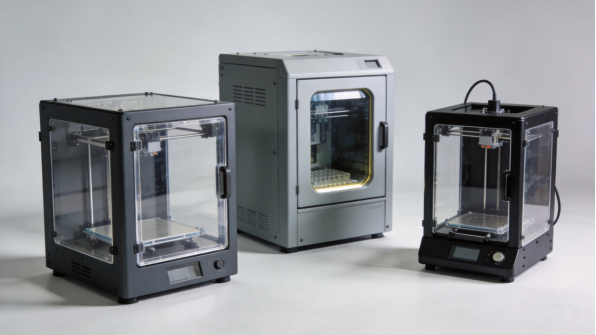
Figure 1: 3D printer enclosures in desktop, industrial, and resin machine formats.
The Product: What Are 3D Printer Enclosures
Enclosure Families and Configurations
3D printer enclosures fall into three main families: desktop FDM printer housings, industrial AM machine cabinets, and resin or specialty machine enclosures. Desktop housings enclose fused filament printers to stabilize chamber temperature and contain fumes, industrial cabinets house larger machines with integrated filtration and access, and resin and specialty enclosures protect materials and operators from the specific process environment.
Within each family, enclosures vary by size, thermal design, and feature set. A desktop housing may be a folded steel and clear panel box with a top vent, while an industrial cabinet can be a welded steel and aluminum assembly with door interlocks, filtration plenums, and cable management. 3D printer enclosure manufacturing spans all of these, and a fabricator that handles precision forming, welding, and assembly can supply the full range to printer OEMs.
Core Components and Their Roles
The core components are the chamber body, the door or access panel, the viewing window, the ventilation system, and the internal mounting structure. The chamber body defines the heated volume and holds the temperature, the door provides access for setup and part removal, and the viewing window lets users monitor prints without opening the chamber. Ventilation manages fumes, and internal mounting locates the print bed, motion system, and electronics.
Seals and gaskets close the chamber around the door and cable pass-throughs, and insulation may be added to hold temperature in heated machines. Every component is a fit point, and the enclosure design must hold tolerances so doors seal, windows fit, and the machine assembles without forcing. The design also must support service access, because a printer that is hard to service fails in the field.
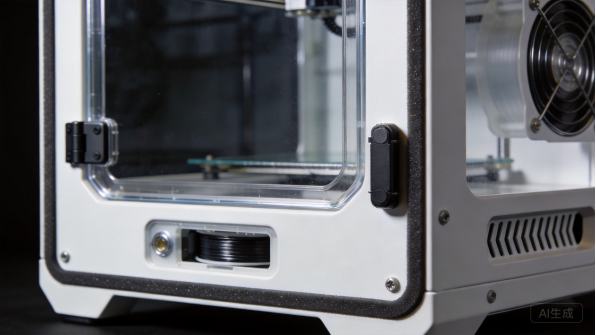
Figure 2: Enclosure details include clear doors, seals, pass-throughs, and ventilation.
Design Drivers: Temperature, Safety, and Visibility
3D printer enclosure design is driven by chamber temperature control, operator safety, and print visibility. Fused filament printing benefits from a stable chamber temperature that reduces warping, so the enclosure is built to retain heat with minimal loss, and heated chambers use insulation and controlled venting. Resin and industrial processes add emission management, with filtration or exhaust connections built into the housing.
Safety separates the operator from hot surfaces, moving parts, and process emissions, with interlocks, ventilation, and materials that resist heat and flame. UL safety evaluations cover electrical and fire risk, and America Makes and industry groups share practice for safe operation. Visibility keeps the process observable through clear panels sized and positioned for the build volume, and these drivers are settled at quotation.
Customization in 3D Printer Enclosure Manufacturing
Custom 3D printer enclosure manufacturing exists because every machine has its own build volume, thermal profile, and feature set. Buyers customize chamber dimensions, window layouts, door systems, ventilation, filtration, colors, and branding, and they expect the enclosure to accept their motion system and electronics. Custom fabrication also supports product families: one chassis platform can serve several build volumes.
Customization includes compliance details such as interlocks, grounding, labels, and documentation for the machine’s certification. ANSI and related standards inform construction, and buyers increasingly ask for documented materials and test evidence. A fabricator that can provide material certifications and consistent batch quality gives printer OEMs the file they need for UL and market approvals.
Use Cases and Applications
Desktop Engineering and Education
Desktop 3D printers serve engineers, schools, and makers, and enclosures are standard on professional desktop models to stabilize prints and contain fumes. The enclosure must fit the desktop, allow clear viewing, and keep noise and odor low, which drives compact forming and vented panel design. OEMs sell these machines worldwide, and the housing carries the product’s design language.
For desktop programs, cost and finish matter as much as function. The enclosure is produced in volume against product launches, and brands order housings ready to accept their motion and electronics. 3D printer enclosure manufacturing serves this volume with repeatable forming, painting, and assembly, and OEMs value fabricators that deliver consistent quality on launch schedules.
Desktop models also benefit from a shared enclosure platform, which keeps service parts and tooling common across the range.
Professional Services and Print Farms
Professional service bureaus and print farms operate many printers at once, and their enclosures must work in dense, organized installations. Consistent size, reliable door and ventilation design, and easy service access keep a farm productive, and enclosures are often racked or shelved in rows. Service operators value enclosures that are interchangeable across machines.
Print farm programs are volume purchases by service companies and resellers, ordered against fleet expansion. The enclosures must assemble cleanly, hold temperature predictably, and accept the same control and ventilation options across units. For fabricators, print farm work adds steady volume and repeat configurations, and it demonstrates the consistency that production environments require.
Farm operators also track enclosure temperature consistency, because part quality depends on stable chambers across machines.
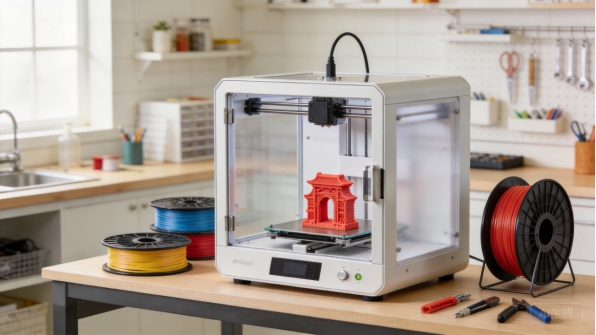
Figure 3: A desktop printer runs inside its enclosure in a professional workshop.
Industrial Additive Manufacturing
Industrial additive manufacturing machines build parts for aerospace, medical, and automotive programs, and their cabinets are engineered for process control, safety, and certification. These machines use heated and filtered chambers, interlocks, and integrated handling, and the enclosure is part of the qualified process. ASTM additive manufacturing standards and machine qualification programs shape what the industry expects.
Industrial programs are specification-driven: the machine must qualify for the application, and the enclosure construction and documentation support that qualification. Buyers need material and test evidence, and delivery is scheduled against machine builds. For fabricators, industrial AM work is lower volume but high value, and it demonstrates the welding, sealing, and documentation capability that advanced machines require.
Qualified machines also require documented change control, which the fabricator supports with revision records and material traceability.
Resin, Dental, and Specialty Printing
Resin printers, dental 3D printers, and specialty machines use enclosures that manage material safety and process environment. Resin machines need fume containment and cleanable interiors, dental machines serve clinics with hygiene expectations, and specialty processes may require inert atmospheres or specific ventilation. The enclosure supports these process requirements with sealed construction and controlled airflow.
These programs are often application-specific, ordered by OEMs and dental equipment suppliers against product lines. The enclosure must match the machine’s process and the operator’s environment, and documentation supports market approval. For fabricators, resin and specialty work adds design content and demonstrates sealed construction and finishing capability.
Clinic and lab units are ordered against equipment schedules, and service kits keep replacement doors and filters available.
Material Selection
Steel for Structure and Fire Safety
In 3D printer enclosure manufacturing, cold-rolled steel is the standard structural material, providing stiffness, fire resistance, and cost-effective construction, and its mechanical properties are documented in references such as MatWeb’s materials database for comparison. Powder-coated steel carries the chassis, doors, and panels, and steel’s fire performance supports the machine’s safety case.
Typical thicknesses range from 0.8 mm for desktop panels to 1.5 mm for industrial cabinets that carry heavier hardware. The coating does the environmental work: powder coating, applied electrostatically and cured, forms a durable film, and the Powder Coating Institute publishes coating guidance with performance verified under ASTM International standards. Dark greys and blacks dominate printer aesthetics.
The coating is also checked for edge coverage, because cut edges are where a heated chamber sees the most thermal cycling.
Aluminum for Thermal and Lightweight Design
Aluminum appears where heat transfer and weight matter: heated chamber structures, internal heat sinks, and desktop frames that must be light enough to ship and move. Aluminum conducts heat well, which helps distribute chamber temperature, and its properties are cataloged by references such as AZoMaterials. Extruded aluminum profiles frame larger machines and carry the clear panels.
Aluminum is about one-third the weight of steel and resists corrosion naturally, and it is isolated from steel at joints to prevent galvanic corrosion. Aluminum also simplifies internal cable routing with formed channels, and for desktop and mid-size machines aluminum framing balances stiffness with weight. For fabricators, aluminum capability supports the modern, lighter look of professional desktop printers.
Extruded aluminum profiles also create the clean channel geometry that holds panels and cable routing in modern machines.
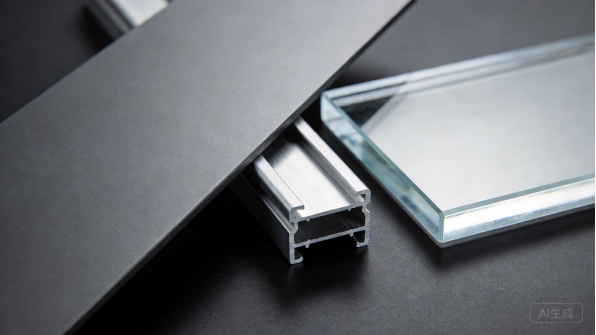
Figure 4: Coated steel, aluminum frames, and clear panels cover the enclosure material range.
Clear Panels and Windows
Viewing windows are a defining feature of 3D printer enclosures. Polycarbonate is the most common clear panel: it is strong, lightweight, and tolerates the chamber environment, while acrylic offers clarity at lower cost and glass serves high-heat industrial chambers. Panels are mounted in formed frames with gaskets or adhesive systems, and their fit and seal keep the chamber closed.
Clear panel selection considers UV resistance, scratch resistance, and the machine’s operating temperature. Anti-glare and tinted options support specific materials and lighting. The window frame tolerances decide whether the panel seals and stays in place under temperature cycling, and replacement panels are part of the service kit.
Clear panel clarity and haze are verified on first articles, because print visibility is a selling feature buyers check first.
Seals, Filtration, and Hardware
Seals and filtration complete the chamber. Silicone and EPDM gaskets close the door and pass-throughs, and filtration plenums or exhaust adapters manage emissions on enclosed machines. HEPA or carbon filters are integrated where the process requires, and the vent system is sized to the material’s emission profile.
Hardware finishes the enclosure: hinges, latches, door interlocks, leveling feet, and cable glands are selected for repeated access and safety. Interlock switches and grounding are specified with the electrical design. Agreeing the seal, filtration, and hardware specification at quotation prevents the most common field issues: temperature drift, odor leaks, and doors that do not close cleanly.
Filter housings and vent adapters are also formed to accept standard filter sizes, which keeps replacement parts available.
Production Difficulty
Laser Cutting and Cutout Precision
3D printer enclosure manufacturing begins with laser cutting, which produces the chassis panels, doors, and the cutouts for windows, vents, and connectors. Fiber laser systems hold tolerances around plus or minus 0.1 mm, and at XHX Metal two 6kW fiber laser cutting machines deliver plus or minus 0.01 mm positioning accuracy, which matters when window openings and door frames must align across the enclosure.
Cutout quality is visible on a printer: burrs around window openings damage seals, edge roughness around vents collects dust, and pierce points must sit in hidden areas. Nesting software arranges parts to minimize scrap across the enclosure set, and cutting parameters are tuned per material and thickness. The cutting stage decides whether windows seal, doors align, and the machine looks finished.
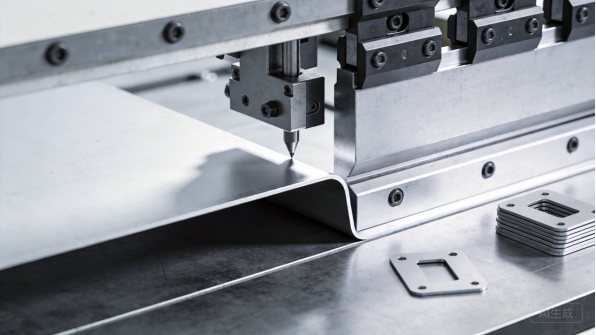
Figure 5: Precision bending forms enclosure panels to tight geometry.
CNC Bending and Enclosure Geometry
Bending converts flat blanks into the chassis, panels, and door frames, and the large panels of an industrial cabinet demand careful forming: a slight bend error across a long panel becomes a visible gap at the seam. Springback compensation is tuned for each material, and Engineers Edge publishes bend allowance and deduction references used to lay out blanks and predict finished dimensions.
Modern CNC press brakes with programmable back gauges hold bend positions and angles consistently, and first articles are verified against the drawing before production. For printer enclosures, the critical checks are door opening geometry, window frame flatness, and chamber seal surfaces, because the machine’s temperature and safety depend on a closed chamber. These measurements are checked on the first article and sampled during production.
Chamber seal surfaces are kept clean of paint buildup by masking, so the gasket lands on bare metal.
Welding, Assembly, and Panel Mounting
Welding joins structural chassis and brackets, while lighter frames use fastening and clinching to protect coatings and allow service. TWI Global provides technical guidance on joining thin metals, and fixtures hold parts to geometry during assembly. Window panels are mounted with gaskets and retainers, and the seal is checked around the full perimeter.
Assembly fits the door, interlocks, ventilation, and hardware, and the chamber is checked for seal continuity and door operation. For printer OEMs that assemble the machine in house, the fabricator ships enclosures ready for their motion and electronics. Fixture-based assembly and seal checks keep quality consistent across production, and a sample build validates the complete chamber.
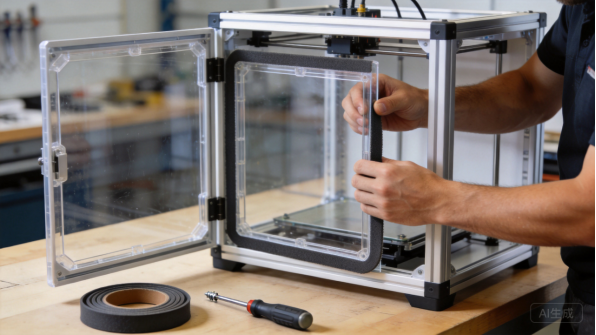
Figure 6: Clear panel and seal installation completes the chamber.
Quality Control and Safety Verification
Printer enclosure quality control combines dimensional inspection with functional and safety checks. First articles are inspected against the drawing, verifying door fit, window sealing, and mounting, and production batches follow a control plan with sampling. Seal continuity, door interlocks, and coating quality are checked at defined points, and a representative enclosure is tested with the machine’s thermal load.
Safety verification supports the machine’s certification: temperature stability, vent performance, and interlock function are documented, and UL practice guides the test program. Buyers need the evidence for market approval and customer qualification. A fabricator that coordinates thermal and safety verification gives printer OEMs the data they need for launch.
Thermal reports are issued per chamber configuration, so the OEM can qualify each model once.
Production Lead Times
RFQ, Engineering Review, and Prototypes
A 3D printer enclosure manufacturing program starts with an RFQ: drawings or machine specification, material, finish, quantities, and target timing. The fabricator’s engineering team reviews the design for manufacturability, checking door fit, window sealing, thermal paths, and assembly, and returns a quotation with comments within one to three business days. Prototypes are typically delivered in ten to eighteen business days because precision enclosures need careful setup.
The prototype is where the enclosure gets validated: the door is opened and closed, the window seal is checked, and the machine’s thermal load is simulated. Prototype feedback should include fit notes and suggested drawing changes. For printer programs, a fully assembled sample with the machine’s hardware, not just the shell, is worth the cost because it proves the chamber works before production.
OEMs with approved enclosures can move straight to quotation, because the design is already validated with their machine.
Tooling and Process Setup
Most 3D printer enclosures are produced with laser cutting, CNC bending, and light machining, which keeps tooling costs low and design changes inexpensive. The setup that matters is process tooling: bending programs with verified parameters, welding and assembly fixtures, and inspection gauges for door and window fit. Building this setup typically takes one to two weeks for a new enclosure.
Because printer volumes are moderate, dedicated stamping dies are rarely justified; the economics are reviewed at quotation, and flexible fabrication is usually the right route. Buyers should expect the fabricator to confirm the flexible route rather than assume expensive tooling is required.
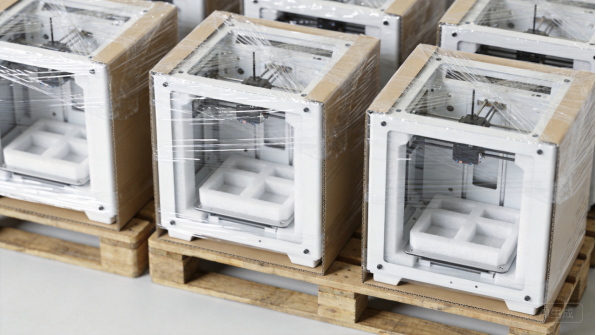
Figure 7: Enclosures ship with protected clear panels and foam packaging.
Production Batches and Volume Planning
In 3D printer enclosure manufacturing, production runs are moderate: a desktop enclosure family typically ships 200 to 500 units per month in batches of 100 to 200 units, while industrial cabinets run in smaller batches because they are larger assemblies. Typical lead times are 20 to 35 business days, with forming, finishing, and assembly consuming the largest share.
Forecast sharing keeps batch lead times stable. When OEMs share rolling forecasts, the factory reserves material and finishing capacity and orders long-lead items such as custom colors or clear panel sizes in advance. Steel and standard aluminum are usually on hand, while custom finishes and glass panels may add one to two weeks. A clear schedule with milestone dates makes the bottleneck visible before it becomes a launch delay.
Launch programs are also staged with agreed safety stock, so the OEM can support service and channel demand between releases.
Packaging, Logistics, and Documentation
Printer enclosures ship in packaging matched to the product: coated panels protected by film and foam, clear panels separated with protective sheets, and units packed in cartons for export. Export shipments use rust-preventive paper or VCI film against container condensation, and the fabricator should provide carton dimensions, gross weight, and loading photos for freight planning.
Documentation accompanies every shipment: packing lists, material certificates, finish records, and test reports where agreed. Printer OEMs need records for certification, and buyers should confirm the documentation set during quotation. Communication follows clear milestones, with photos at each stage, so OEMs can track progress without site visits.
For printer programs, carton marking includes model identifiers, which speeds kitting and fulfillment.
Past Case Studies
Desktop Printer Brand: Enclosure Line
A desktop 3D printer brand needed an enclosure line for its new professional models, with powder-coated steel chassis, clear front doors, and integrated venting. The program runs at 250 to 400 enclosures per month with a minimum order of 100 units, priced from $55 to $140 FOB depending on size, for an annual value of roughly $360,000.
XHX Metal delivered the first article assembly in 15 business days, and the first batch of 200 enclosures shipped in 24 business days. Monthly releases now follow the brand’s launch plan, and door and window sealing are verified on a sampling basis. The brand added a taller enclosure for its large-format model in the second year, and the program now supports three product lines.
The program shows how 3D printer enclosure manufacturing scales across model generations.
Industrial AM OEM: Machine Cabinets
An industrial additive manufacturing OEM needed machine cabinets for a qualified polymer system, with heated and filtered chambers, door interlocks, and documentation for machine qualification. The program runs at 30 to 60 cabinets per month with a minimum order of 20 units, priced from $700 to $1,400 FOB depending on configuration, for an annual value of roughly $320,000.
First articles were thermal tested and interlock verified, and the first batch of 40 cabinets shipped in 34 business days with material certificates and test records. The cabinets passed the OEM’s qualification review, and the program expanded with a second machine size. The program showed how sealed construction and documentation serve qualified industrial machines.
The OEM now lists replacement doors and filter kits in its service catalog, stocked for field support.
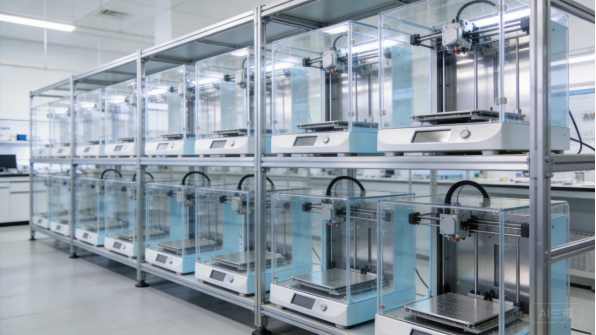
Figure 8: Industrial and desktop printers run in enclosures across a professional lab.
Service Bureau: Print Farm Enclosures
A service bureau expanding its print farm needed enclosures for 200 additional printers, ordered in batches with consistent dimensions and service access. The program runs at 300 to 500 enclosures per month with a minimum order of 150 units, priced from $40 to $90 FOB depending on size, for an annual value of roughly $250,000.
First articles were verified and the first batch of 300 enclosures shipped in 22 business days. The bureau standardized the enclosure across its fleet, and spare doors and panels ship from the same monthly production. A vented variant with filter adapter was added for the bureau’s enclosed print room in the second year, and the bureau program shows how 3D printer enclosure manufacturing scales with print farm expansion.
Dental OEM: Resin Machine Enclosures
A dental 3D printer OEM needed resin machine enclosures with cleanable interiors, fume containment, and a compact footprint for clinics. The project covered 500 enclosures with a minimum order of 150 units, priced from $70 to $150 FOB depending on configuration, for a total value of roughly $55,000.
First articles were inspected for seal integrity and interior finish, and production shipped in two batches with material certificates and finish records. The OEM approved the enclosures for its clinical line and ordered a larger multi-resin variant the following quarter. The program showed how sealed, cleanable construction serves resin and dental applications.
The larger variant shares the same door and seal system, which keeps spare parts common across the clinical range.
Summary and Next Steps
Key Takeaways
3D printer enclosure manufacturing is a temperature, safety, and precision-sensitive discipline that demands more than sheet metal work. The material decision drives cost and performance, from coated steel for structure and fire safety to aluminum for thermal design, and clear panels, seals, and filtration must be specified for the process. Production difficulty concentrates in door and window fit, chamber sealing, and safety verification, which are exactly where experienced fabricators differentiate themselves.
Lead times follow a predictable path: engineering review in days, prototypes in two to three weeks, process tooling in one to two weeks, and production in three to five weeks per batch, with runs of 30 to 500 units depending on enclosure size. Forecast sharing and staged delivery planning keep OEM programs on schedule. Buyers who settle materials, thermal targets, and documentation requirements before quoting will have smoother programs than those who discover requirements at machine qualification.
Why XHX Metal
XHX Metal is a privately owned sheet metal manufacturer in Dongguan, China, with a 2,000 square meter factory, about 30 employees, and an annual capacity exceeding 500,000 pieces. The factory operates under an ISO 9001:2015 quality management system with CE and SGS certifications, and it produces custom enclosures, chassis, panels, and assemblies for export customers with packaging designed for ocean freight. Two 6kW fiber laser cutting machines, CNC press brakes, and TIG and MIG welding cover the fabrication side of printer enclosure work.
The company supports buyers from design review through production, provides first-article inspection reports and material certificates, and coordinates thermal, coating, and dimensional verification when required. For 3D printer enclosure manufacturing programs, buyers can review related sheet metal fabrication services and product pages, and the team will structure quotations, quality documentation, and delivery schedules to match the program’s needs.
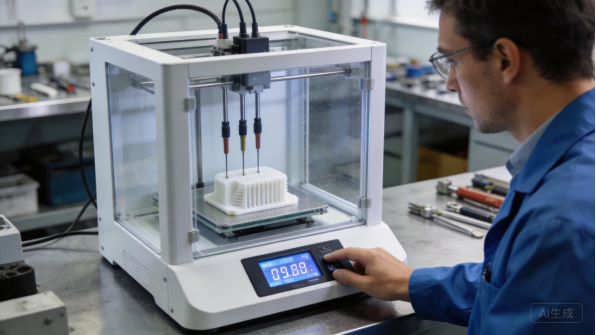
Figure 9: Thermal and safety testing verifies the enclosed chamber before shipment.
How to Start Your Project
Start with a STEP or STP file and a drawing that states material, finish, thermal target, quantities, and documentation needs. If the design is not finalized, send photos or sketches of the printer, the build volume and motion system, the materials you print, and the annual volume, and the engineering team will recommend a manufacturable, safety-ready design. The typical path is: engineering review, quotation, prototype, first-article inspection, production, and shipment, with clear communication at each milestone.
To discuss a printer enclosure program, contact Barry at +86 13244963694 or sales01@xinghaoxin.com, or send your design through the XHX Metal website. With clear requirements and the right partner, a 3D printer enclosure moves from drawing to production in weeks, with fit, sealing, and safety performance that pass machine qualification.
What to Ask a Fabricator
Before placing an order, ask the fabricator three questions: which materials and clear panel systems it handles for heated chambers, how it verifies door and window sealing on first articles, and what thermal, interlock, and dimensional documentation it can provide. The answers reveal whether the shop treats printer enclosures as engineered chambers or as simple metal boxes.
Also confirm experience with door interlocks, filtration integration, and export packaging, because those details decide whether a machine qualifies and ships cleanly. A fabricator that lists test methods and acceptance criteria in the quotation is treating quality as part of the product, and that is the partner worth building a printer line with.