Custom metal picture frame manufacturing turns a buyer’s own photograph, sketch, or outline into a finished metal piece: the silhouette, the outer shape, the material, the finish, the backing, the fixing, and the retail packing are all specified by the customer. For pet portrait and home decor brands in North America and Europe, the value is a product that exists only in their own range.
This guide explains how far that customisation can go. It covers the formats a cut metal piece can take, the materials and finishes available, the production risks that decide whether a design survives batch manufacturing, the files and lead times involved, and three production programmes with real purchasing data behind them.
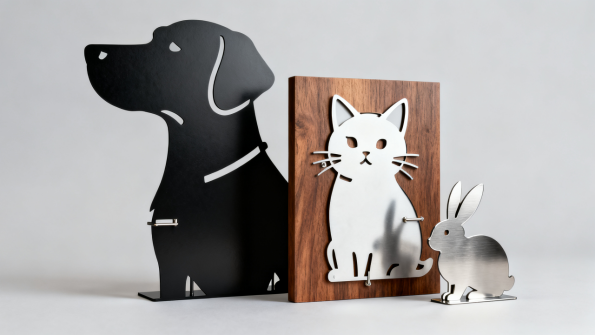
Figure 1: Custom cut metal pet portrait panels produced in one process across different sizes, materials and finishes.
The Product: What Custom Metal Picture Frames Can Be
What Custom Metal Picture Frame Manufacturing Covers
Custom metal picture frame manufacturing covers every part of a decorative metal wall piece: the cut silhouette, the outer outline, the sheet material, the finish, any backing board, the fixing method, and the retail packing. The factory owns the whole item rather than supplying a single component, which is the engineering discipline described by SME.
This is not a conventional picture frame. A conventional frame is a profile cut to length, mitred, and fitted with glazing; the customer supplies the artwork and the frame only holds it. A cut metal piece is the artwork itself. The silhouette, the negative space, and the bridges that hold fine detail together are all part of the manufactured item.
XHX Metal produces these pieces from drawing to delivered parts inside one factory: two 6kW fiber laser cutting machines, CNC punching and bending, TIG and MIG welding, deburring, and coating partners. The wider scope is set out on the sheet metal fabrication services page.
Formats: One-Piece Cut-Outs, Backed Panels, and Round Plaques
Three formats cover most orders. A one-piece cut-out panel carries its own border and needs no backing. A backed panel fixes a cut silhouette to a wooden or acrylic board. A round or shaped plaque uses a closed outline for signs, house numbers, and scene pieces. All three come from the same cutting process; only the assembly step changes.
The one-piece cut-out is the most direct format to scale, because the border and the internal detail are cut from a single sheet. The structural risk sits in the border: a border narrower than about three times the sheet thickness can twist after cutting. A backed panel adds stiffness, so a finer design can be cut thinner, and the two parts are fixed with countersunk screws or rivets.
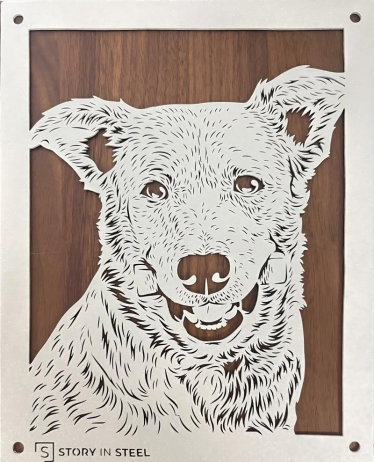
Figure 2: A production pet portrait panel cut in powder coated steel and fixed to a wooden backing board.
Shapes, Sizes, and Custom Outline Options
Sizes typically run from a 150 mm tabletop piece to a 1,200 mm wall panel, and any outline can be produced as long as the sheet size allows it. Rectangles, circles, ovals, shields, letter shapes, and irregular outlines are all cut from the same blank. The capabilities of the process are described by the Laser Institute of America.
Fine detail behaves differently at different sizes. A design that reads well at 600 mm can lose its smallest openings at 200 mm, because the kerf and the minimum bridge width stay roughly constant while the artwork shrinks. Reviewing the smallest feature at final size, rather than on screen, avoids most of these problems.
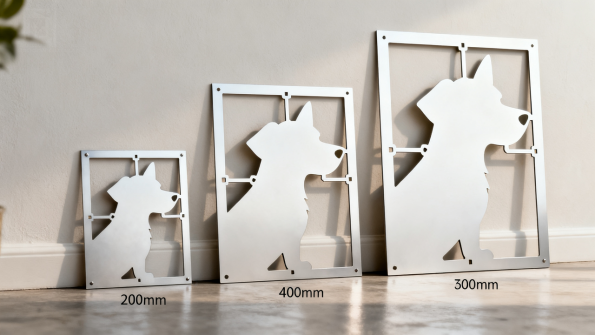
Figure 3: The same design produced at three sizes, showing how cut detail and border scale with the panel.
Use Cases: Who Orders Custom Metal Picture Frames
Pet Portrait and Personalised Gift Businesses
Pet portrait and gift businesses order cut metal silhouettes from customer photographs, usually in mixed batches where every unit is a different animal. They need fast artwork turnaround, a proof the end customer can approve, and consistent cutting quality across a batch of unrelated designs.
This is the channel where the artwork service carries most of the value. A photograph with a clear single subject and reasonable contrast converts into a strong silhouette; a busy background or a low-resolution image needs a different treatment, and saying so before production is far better than delivering a weak likeness afterwards.
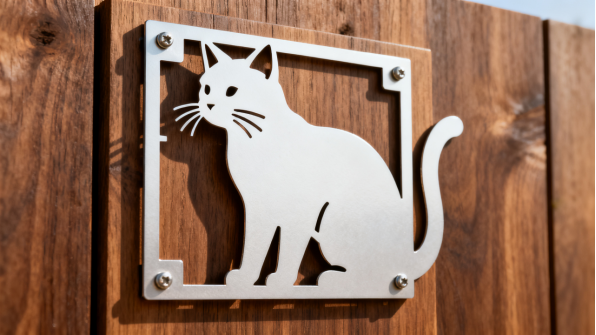
Figure 4: A cut metal pet portrait held off a walnut backing board by four countersunk screws.
Home Decor and Interior Brands
Home decor brands order pet-themed cut metal pieces as part of a designed collection, so colour, outline, and pack presentation matter as much as the cut itself. They usually launch two or three finishes, test them, then reorder the winners in batches of a few hundred pieces.
These buyers release seasonal collections, which means frequent, moderate batches with reorders when a style sells through. They need consistent colour from batch to batch, because a shade difference is obvious when two pieces hang on the same wall, and they need drop-tested packing because the piece reaches the consumer by parcel. Consumer product safety expectations for wall-hung goods are set out by the US Consumer Product Safety Commission.
DIY Kits, Craft Channels, and Unfinished Stock
DIY kits ship the metal part unfinished so the end customer completes it: bare steel for painting, a loose backing board, and a screw pack. Craft and hobby channels order these in the same batches as finished pieces, and they are the easiest way to add a lower price point without a second tooling set.
The manufacturing difference is mostly in finishing and packing. Bare steel needs a protective oil film or a paper interleaf to survive shipping without flash rust, edges must be deburred more carefully because the customer handles them directly, and any wall template must be printed at true size. A template printed at 97 percent scale is a common and entirely avoidable complaint.
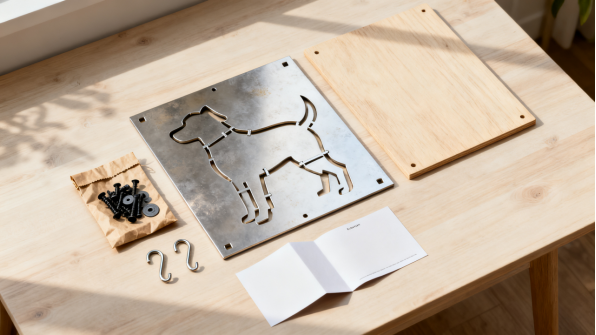
Figure 5: An unfinished DIY kit: bare steel cut-out panel, backing board, hardware pack, hooks and mounting template.
Materials, Finishes, and Customisation Options
Steel, Stainless Steel, and Aluminium
Mild steel is the default for painted decorative pieces, stainless steel is chosen for outdoor and coastal use, and aluminium is chosen where weight matters. All three cut, deburr, and finish well; the choice is decided by where the piece will hang.
Mild steel takes powder coating well and is the most economical substrate, but it must be coated because bare steel rusts outdoors. Stainless steel, usually grade 304 and grade 316 in coastal air, can be left bare or brushed; guidance for stainless sheet is published by SSINA. Aluminium weighs about a third of steel at the same thickness and is softer on the surface, and alloy guidance is available from the Aluminum Association.
Powder Coating: Colour, Texture, and Two-Tone
Powder coating is the standard finish: any RAL colour, in matte, satin, gloss, or textured form, applied over a pre-treated surface and cured to a controlled film thickness. A colour change costs nothing beyond the powder lot, which makes it the most flexible finish for a custom range.
Colour matching is the main risk in a painted range. Two batches sprayed weeks apart will not match by accident, so one powder lot per order, recorded cure parameters, and a retained sample are the controls that matter. Two-tone work shows the flexibility of custom metal picture frame manufacturing: a mask protects one area while a second colour is applied, so a piece can carry a black border with a bare steel centre. Masking adds handling and reject risk and is quoted as its own operation. Coating practice is described by the Powder Coating Institute, and coating chemistry for the European Union falls under EU REACH.
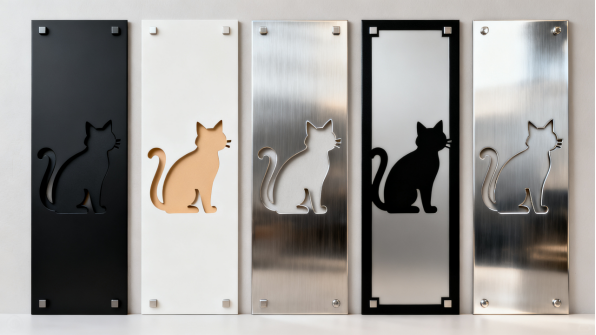
Figure 6: One pet portrait design produced in matte black, warm white, brushed steel, polished steel and two-tone finishes.
Backing Boards, Mounting, and Hardware
Backing and mounting are where the manufacturing process moves beyond cutting. A backing board can be wood, MDF, acrylic, or painted steel, fixed with screws, rivets, or adhesive. Mounting options include keyhole slots, punched holes, welded studs, magnetic plates, easel stands, and a simple sawtooth hanger, and the choice has to match both the wall and the customer’s ability to install it.
Backing choice is visual and structural at once: a dark backing makes a pale silhouette read as a shadow, and it also stiffens a fine design. Fixings should be standardised across a range so one template and one instruction sheet serve every size; hardware and thread standards are published by ANSI. Every order should include a sealed hardware envelope with a spare fastener. The assembled scope is listed on the product range page.
Production Difficulty and Quality Risks
From Photo or Sketch to a Production Cut File
The first quality risk appears before any metal is cut: the artwork has to become a vector file whose paths the laser can follow. A photograph is traced into a line drawing, and that drawing is what the buyer approves, not the photograph it came from.
The tracing step decides likeness. A good silhouette keeps the subject’s outline and the few internal details that identify it, and deliberately drops the rest. Buyers should review the proof at the size the piece will be produced, because a line weight that looks delicate on a monitor can be too thin to hold once it is cut. We return the proof as a line drawing plus a rendered view, and record the approved revision number so a reorder rebuilds the same file.
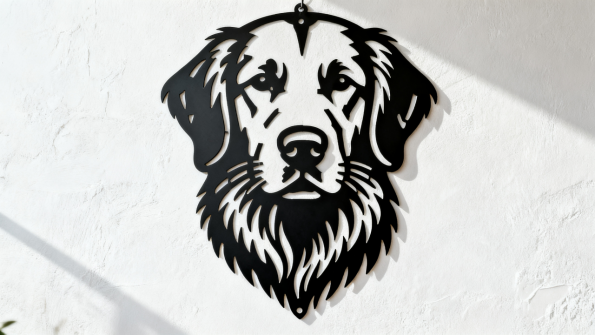
Figure 7: A finished pet portrait panel in matte black powder coating, hanging ready for the end customer.
Thin Bridges and Minimum Cut Width
Any element that is not connected to the rest of the panel will fall out of the sheet. Keeping a piece together means designing bridges, which are short lengths of uncut material, and respecting a minimum bridge width that depends on the sheet thickness.
As a working rule, a bridge should be at least as wide as the sheet is thick at its narrowest point, and around 1.5 times the thickness for pieces shipped individually. A bridge that is too narrow survives cutting but fails later, either in the coating line or in the customer’s hands. Floating elements, such as the pupil of an eye with no connection to anything, are fixed with a hidden bridge, a redesign, or a backing board; the buyer should be told which option is proposed and why.
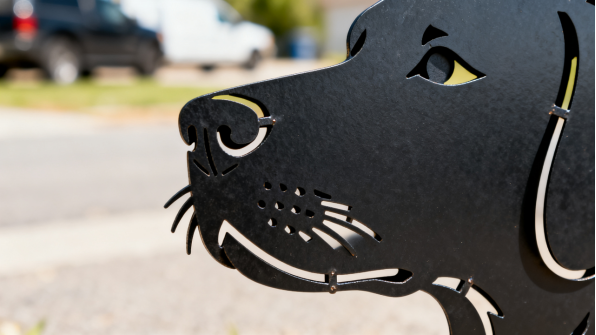
Figure 8: Narrow bridges holding fine detail such as whiskers and fur strands on a deburred, powder coated cut edge.
Distortion, Burrs, and Coating Consistency
Laser cutting puts heat into a thin sheet, so long narrow pieces can bow or twist, and the cut edge carries a small burr. Both are controlled by nesting, cut parameters, and a deburring step rather than by inspecting the problem afterwards. On a decorative piece the customer will run a finger along the edge, so a burr is a defect here, not a detail.
Coating coverage is the third risk. Powder reaches outer faces easily but struggles at the back of a deep cut and inside narrow openings, where the charge cannot pull it into shadow, so coverage has to be designed in. Flatness is checked against a straight edge or surface plate, following the metrology guidance published by NIST. Buyers comparing quotations should ask for the film thickness range and the pre-treatment method in writing.
Lead Times, Files, and Order Flow
What You Send Us: Photos, Sketches, and Drawings
Every custom metal picture frame manufacturing enquiry starts from the same small set of inputs: the artwork or the idea, the finished size or the range of sizes, the intended material and finish, the mounting method, the quantity and release pattern, and the packing standard.
A photograph should be the highest resolution available, taken straight on against a simple background; a phone photograph is often enough, but a screenshot usually is not, because compression removes exactly the edge detail the tracing step depends on. Buyers with drawings send a DXF or STEP file for the outline and a dimensioned 2D drawing for anything that must fit something else. Material standards for aluminium products are documented by bodies such as European Aluminium.
Batch Volumes, MOQ, and Realistic Pricing
Decorated cut metal is a small-item product. Realistic volumes run from 200 to 800 pieces per batch over four to eight releases a year, with a minimum order around 100 pieces and FOB prices typically between $2 and $15 depending on size, material, and finish.
Small tabletop pieces sit at the low end of that range and a large layered or two-tone panel sits at the top, so two quotations for the same silhouette can be a long way apart without either being wrong. First batches usually ship 15 to 25 days after drawing and sample approval, and repeat orders move faster because the cut file, the fixture, and the colour records already exist. The saving from a shared nest, a shared carton, and one coating programme rather than several small orders is larger than most buyers expect.
Assembly, Post-Processing, and Documents
Custom metal picture frame manufacturing at XHX Metal covers cutting, deburring, forming, welding, and finishing the metal part, plus fitting the backing board, installing the mounting hardware, and packing the finished item. Coating is carried out by audited partners for powder coating, galvanising, anodising, and plating, with inspection recorded against the batch.
An order is supported by the approved drawing with its revision number, the vector proof, material certificates, a first article inspection report, batch inspection records, and a packing list. Buyers who need more, including third-party verification of the kind offered by UL, should agree the scope at quotation. Keeping those records makes a reorder straightforward, because the next batch is built and inspected against the same documents rather than against memory.
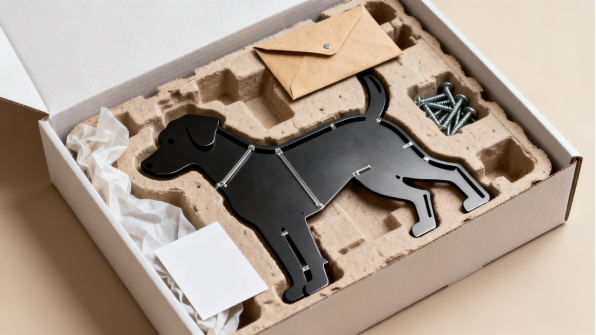
Figure 9: Assembly and packing scope: a wall-ready pet portrait piece in its retail box with hardware envelope and card.
Case Studies: Custom Metal Picture Frame Programmes
Case 1: US Pet Portrait Brand — Two Formats from One Cut File
A US pet portrait brand needed a wall-ready piece and a lower-priced option for its own store, using the same artwork for each. We built both from one cut file: a one-piece panel in 1.5 mm steel with a matte black powder coat, and the same silhouette fixed to a walnut backing board with four countersunk screws.
The programme ran at 250 to 400 pieces per release, four releases a year, with an MOQ of 100 pieces per design family and FOB prices from $5.50 to $12.00. The sample was approved in 7 working days and the first batch of 320 pieces shipped 19 days after approval. Annual value was approximately $29,000, and sharing one nest across the two formats reduced unit cost by about 5 percent in the second year.
Case 2: European Home Decor Brand — Two-Tone Pet Range
A European home decor brand wanted pet portrait wall pieces in a two-tone finish: a black outer border with a brushed steel centre. The pieces were cut in 2.0 mm steel, brushed, then masked so that only the border received powder. Masking was the main production risk, because a slip shows as a hard edge in the wrong place, so it was controlled with a reusable mask fixture per size.
Production ran at 300 to 500 pieces per release, three releases a year, with an MOQ of 150 units and FOB prices from $7.00 to $14.50. First batch lead time was 23 days including the brushed finish and masking, and the first article included a sealed colour sample that stayed with the job. Annual value was approximately $33,000.
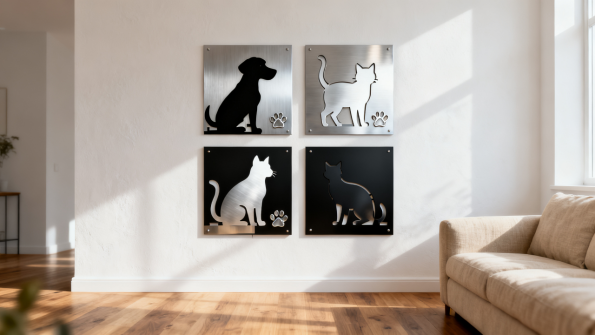
Figure 10: A mixed pet portrait installation, produced from one process in different sizes and finishes.
Case 3: North American Craft Channel — Unfinished Kit Programme
A North American craft retailer wanted an unfinished version of an existing pet portrait design so that customers could paint the piece themselves. The kit used the same cut file, delivered as bare 1.5 mm steel with a protective oil film and a paper interleaf.
Volumes ran at 400 to 800 kits per release, five releases a year, with an MOQ of 200 kits and FOB prices from $2.80 to $6.40. The first batch shipped 17 days after approval and annual value was approximately $22,000. The buyer later added a modular variant in which one backing board accepts four different silhouettes, using the same fixing pattern and requiring no new tooling.
Summary and Next Steps
How to Choose a Custom Metal Picture Frame Manufacturer
The supplier that fits this product can trace artwork, cut and finish the metal, fit the backing and hardware, and pack a retail-ready item under one quality system. Ask to see a vector proof and a finished sample, and ask who performs the tracing: that skill separates a supplier that can cut a file from one that can turn a photograph into a silhouette worth selling.
Check that the quotation states the sheet thickness, the material grade, the finish and its film thickness, the hardware, and the packing grade; a quotation built only from a size and a colour is not a specification. Finally, match the supplier to the batch size: XHX Metal operates at 2,000 sqm with about 30 staff and an annual capacity of 500,000 pieces.
Why XHX Metal
XHX Metal provides custom metal picture frame manufacturing from drawing to delivered parts: artwork tracing, cutting on two 6kW fiber laser cutting machines to plus or minus 0.01 mm, deburring, forming, welding, coating through audited partners, hardware assembly, and export packing.
The company has produced decorative metal pieces and sheet metal products for export customers from Dongguan, Guangdong since 2014, and holds ISO 9001:2015 certification with CE documentation and SGS records. Samples in 5 to 10 working days, first batches in 15 to 25 days, orders from 100 pieces, and mixed batches where every unit is a different design are all normal work.
How to Start Your Custom Programme
Send the artwork, the finished size, the quantity, the material and finish if known, and the mounting and packing you need. We reply with a manufacturability review and a quotation, and a sample follows in 5 to 10 working days after proof approval. If the product is still an idea, a reference photograph and a target size are enough to start.
Programmes are handled directly through the contact page.
FAQ: Custom Metal Picture Frame Manufacturing
Can you make a custom metal picture frame from our own photograph?
Yes. Send the highest-resolution image you have and we trace it into a vector silhouette you approve before cutting.
What is the minimum order?
MOQ is typically 100 pieces for a design family, spread across sizes and finishes inside that family.
Do you supply unfinished pieces for DIY kits?
Yes, with a protective oil film, a loose backing board, a hardware pack, and a true-size mounting template.
How long does a sample take?
The sample follows in 5 to 10 working days after proof approval, and the first batch ships 15 to 25 days after sample approval.Can you match our brand colour and pack for retail? Yes. Any RAL colour is matched against a sealed sample, and gift boxes, insert cards, and hardware envelopes can be quoted.