EV charging station enclosure manufacturing builds the metal body that carries a charging unit through a decade of weather, vandalism, and daily use: the cabinet, the door and lock, the mounting plate, the pedestal, the seals and drainage, the louvres and fan openings, and the cable entry are all part of the fabricated item. The electronics inside are the customer’s; the structure and its protection are the factory’s.
This guide is written for buyers who have to specify and source that structure. It covers the formats, the materials and corrosion systems, the outdoor protection risks that decide whether a unit passes its ingress test, the standards and documents that travel with an order, and three production programmes with real purchasing data behind them.
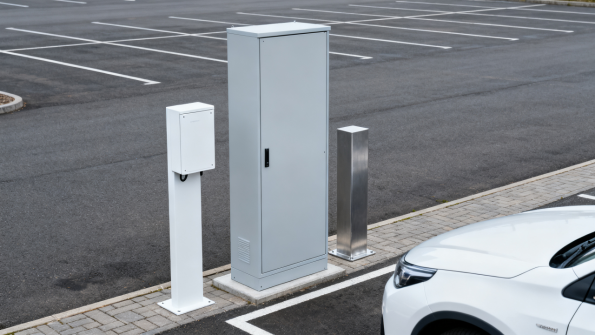
Figure 1: Sheet metal EV charging hardware: a wall-mounted AC enclosure, a floor-standing DC cabinet and a mounting pedestal.
The Product: What an EV Charging Station Enclosure Includes
What EV Charging Station Enclosure Manufacturing Covers
EV charging station enclosure manufacturing covers the fabricated shell and everything that makes it usable outdoors: the cabinet body, the door with its hinge and lock, the internal mounting plate, the rain hood, the louvred air paths, the gland plate and cable entry, the pedestal or wall bracket, and the earth stud.
That is a different scope from the charging module itself. The power stage, the controller, the connectors, and the firmware belong to the customer; the fabricator owns the mechanical envelope that protects them, carries their weight, and keeps water out for years in an unsupervised public location. Confirming that split at quotation prevents the most common dispute in this category: who is responsible when a unit fails in the field.
XHX Metal produces that envelope from drawing to delivered parts inside one factory, using the process control described by SME for custom production work: two 6kW fiber laser cutting machines, CNC bending, TIG and MIG welding, deburring, and coating partners. The wider scope is on the sheet metal fabrication services page.
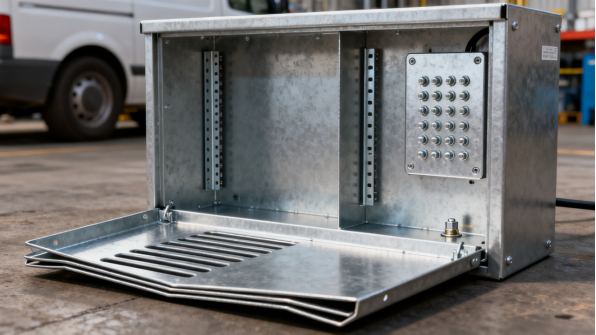
Figure 2: The inside of an empty charging enclosure: folded base tray, removable mounting plate, power compartment divider and earth stud.
Formats: Wall-Mounted, Pedestal, and Floor-Standing Cabinets
Three formats cover most orders. A wall-mounted enclosure suits 7 kW to 22 kW AC units in car parks and apartment buildings, where the wall is available. A pedestal enclosure carries the same unit where there is no wall, adding a welded column with an anchor plate. A floor-standing cabinet houses DC fast charging equipment, which is heavier and needs volume for power modules and cooling.
The format decides most of the engineering that follows. Volume drives the internal layout; the mounting method drives the pedestal, base plate, and anchor pattern; and the daily handling of the door, cable, and connector drives the hardware. Choosing the format early avoids designing a pedestal around a cabinet that later grows by fifty millimetres.
Parts Buyers Order Most
The parts on nearly every order are the cabinet and door, the internal mounting plate with its fasteners, the gland plate, the louvred intake and exhaust panels, the rain hood, the pedestal or wall bracket, and the hardware set. Buyers add a colour specification and, for DC units, a compartment divider.
Repeat buyers add items once the product is in service: an anti-tamper shield over the lock, a spare key, a branded front trim, and an installer template. Those additions cost little per unit but remove a disproportionate amount of field support work, and they are cheaper to specify before the first batch than to retrofit. The product scope is listed on the product range page.
Use Cases: Who Orders EV Charging Enclosures
EVSE Manufacturers and Charging Brands
Charging equipment manufacturers and charging brands order enclosures to their own industrial design, usually with the electronics fitted in their own plant after delivery. They need the sheet metal to match a defined mechanical interface, a colour, and a branding area, and they need every batch to assemble without rework on their line.
For this customer the critical requirement is not the unit price but the interface: mounting hole positions, plate depth, connector cut-outs, and door clearance all have to repeat. A batch that arrives two millimetres out does not fail a cosmetic check, it stops an assembly line.
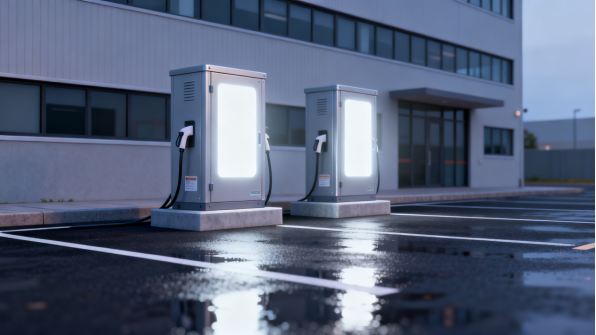
Figure 3: Metal charging enclosures in service at night, with status lighting showing through the front panel.
Charging Network Operators and Fleet Depots
Network operators and depot operators buy replacement enclosures, pedestals, and protective parts for installations that already exist. Volumes are lower and the mix is wider, but the requirement is stricter in one respect: the part has to fit equipment that is already on site, often from a supplier that no longer supports it.
That work starts from a physical survey rather than a drawing. Dimensions are taken from the installed unit, a reverse-engineered drawing is issued for approval, and the first article is checked against the site rather than against a nominal model. It is slower at the start and much faster than a field failure.
Property, Retail, and Municipal Programmes
Property developers, retail chains, and municipalities order enclosures as part of a rollout, and those programmes are driven by schedule rather than by unit cost. Deliveries are staged by site or by phase, and each crate has to be marked for its destination so that a contractor can install without opening every box.
These buyers also care about how the finished unit reads in public. Colour consistency across sites, a legible status light, a tidy cable run, and a pedestal that resists being leaned on all matter as much as the enclosure itself, and all of them are decided at the drawing stage rather than on site. Public charging funding frameworks in the United States and Europe are described by the US Department of Energy Alternative Fuels Data Center and the European Commission.
Materials, Finishes, and Outdoor Protection
Aluminium, Steel, and Stainless Steel
Aluminium sheet between 1.5 mm and 3.0 mm is the default for charging enclosures, because it resists corrosion without a coating, keeps the unit light enough to lift onto a pedestal, and forms cleanly into louvres and folded seams. Alloy guidance for sheet products is published by the Aluminum Association and European Aluminium.
Mild steel is chosen where stiffness or cost matters more than weight, and it then needs a protective system because bare steel rusts outdoors. Stainless steel is reserved for coastal, industrial, and washdown locations, where grade 304 covers most cases and grade 316 is used in chloride-heavy air; material guidance is published by SSINA. The choice should follow the installation environment, not the drawing template.
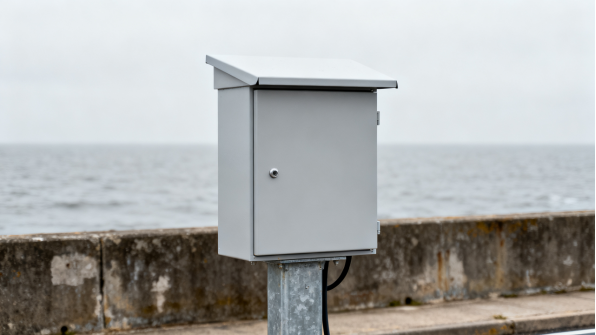
Figure 4: A powder coated charging enclosure on a galvanised pedestal in a coastal installation.
Powder Coating and Corrosion Systems
A powder coating over a correctly pre-treated surface is the standard finish, and on aluminium it is usually a decorative and colour layer rather than the only corrosion barrier. On steel, the coating has to work with a galvanised or zinc-rich substrate, because a coating alone will not protect a cut edge or a scratch in a coastal environment.
Coating practice is described by the Powder Coating Institute, and hot dip galvanising for steel pedestals and frames is covered by the American Galvanizers Association. For a coastal site the specified system, the dry film thickness, and the pre-treatment method should all be stated on the drawing, because a colour name alone does not describe a corrosion system.
Weather Sealing, Drainage, and Condensation Control
Water gets into an outdoor enclosure through four paths: the door seal, the cable entry, the ventilation openings, and condensation forming inside a sealed box as it heats and cools. Each path needs its own detail rather than a general instruction to keep water out.
The door seal belongs in a formed channel rather than on a flat face, so it cannot creep out of position. Cable entries are made through a gland plate with sealed glands, and the plate is set above the base so water standing in the base cannot reach it. Air paths are louvred with a drip edge so that rain entering the louvre drains out before it reaches the filter. Condensation is handled with a drainage path, a formed low point, and a pressure equalisation vent, so the enclosure breathes through a membrane instead of holding moisture against the electronics.
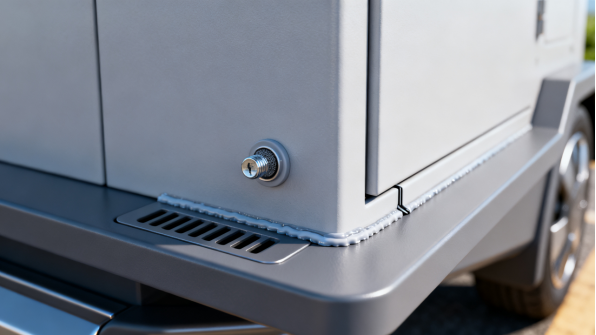
Figure 5: Condensation control: pressure equalisation vent, formed drain slot and sealed folded seam.
Production Difficulty and Quality Risks
Water Ingress and IP Protection
Ingress protection is the first risk in this product, because a single unsealed feature decides whether a unit passes its test. The door gasket, the gland plate, the louvre geometry, and every fastener that pierces the enclosure have to work as one system, and a design that relies on sealant to close a gap will fail once the sealant ages.
The practical controls are design-led: gaskets in formed channels rather than on flat faces, a continuous weld or a folded and sealed seam on the base, drainage that lets water out, and a louvre profile that sheds rather than traps. Before a batch is released we run a water test on the first article and on a sample from the batch, and the test method and duration are recorded so that a later delivery can be compared against the same standard.
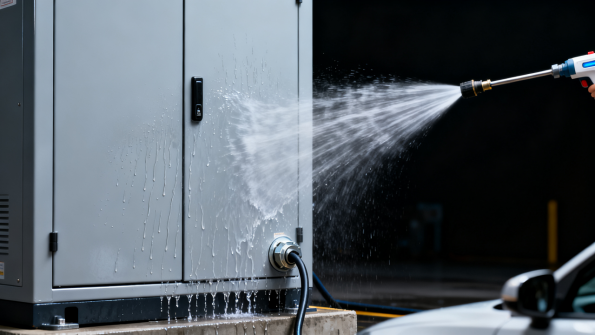
Figure 6: Water ingress testing of a sealed door and gland plate on an outdoor charging enclosure.
Impact Resistance, Door Hardware, and Tamper Protection
Public charging equipment is handled roughly and occasionally deliberately. A door that flexes, a hinge that loosens, or a lock that can be levered open all end the same way: a damaged unit and a repair visit. Impact performance is therefore a design property of the panel, its stiffening, and the door frame, not a separate feature.
Hardware choices carry that performance. Concealed or reinforced hinges spread the load along the door edge; a flush quarter-turn lock with a sealed gasket resists both water and a screwdriver; and a rain lip above the lock keeps water out of the keyway. Anti-tamper shields and security fasteners can be added, and they are worth specifying on units installed in unattended locations rather than adding them after the first incident.

Figure 7: Door hardware: concealed hinge, flush quarter-turn lock, rain lip and reinforced latch plate.
Thermal Design, Flatness, and Batch Consistency
Heat is removed through the sheet metal, so the panel geometry and the air path are part of the thermal design. A louvred intake low on the cabinet and an exhaust high on the opposite face create a natural stack effect; where that is not enough, a filtered fan module is fitted behind the upper grille. Blocking either opening with a flat plate removes the design margin, and installing the intake below the level where water pools defeats it entirely.
Flatness and consistency are the quieter risks. A large powder coated door that twists will not seal, and a mounting plate that is not flat will distort a power module when it is bolted down. Flatness is checked against a straight edge, using the measurement practice published by NIST, and the batch record captures the setting so that a repeat order reproduces it rather than approximating it. Thread and fastener standards are published by ANSI.
Specifications, Compliance, and Order Flow
Standards, Specifications, and Compliance Documents
The enclosure is a component of a certified product, so most buyers need the sheet metal to support a certification route rather than hold one itself. What the fabricator supplies is dimensional records, material certificates, weld and finish records, and a consistent part that the customer’s own test house can evaluate.
Connector and charging system standards are published by bodies such as SAE, and product safety evaluation for charging equipment is carried out by laboratories such as UL. Buyers should state at quotation which documents they need, including material certificates, first article inspection reports, batch records, and a packing list, because assembling that package retroactively is far more expensive than agreeing it at the start.
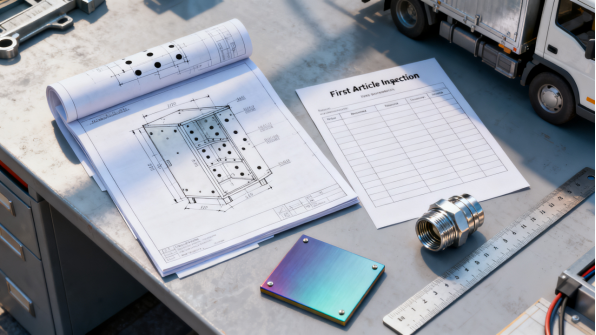
Figure 8: The documentation package for an enclosure programme: drawing, first article report, colour sample and hardware.
Prototypes, Tooling, and Lead Times
A new enclosure normally starts as a prototype in 5 to 10 working days after the drawing is approved, built with production tooling so that the sample proves the process rather than a workshop shortcut. First articles are checked against the drawing for dimensions, hole positions, flatness, seal fit, and hardware function, and the report is issued for approval before the batch is released.
Tooling is usually limited to form tools, weld fixtures, and a drill or punch template for hole patterns. Those items are quoted openly, they stay with the programme, and they are what makes the second and third batches fast. Lead time for a first batch is normally 15 to 30 days after sample approval, and it extends towards the upper end for large DC cabinets that need a welded frame, a galvanised pedestal, and a two-colour finish.
Batch Volumes, MOQ, and Realistic Pricing
Charging enclosures are a mid-size or large-item product depending on the format. Wall-mounted AC enclosures typically run at 50 to 300 pieces per batch with an MOQ of 20 to 50 pieces and FOB prices from about $15 to $80. Floor-standing DC cabinets are larger items, running at 10 to 40 pieces per batch with an MOQ of 5 to 10 and FOB prices from about $100 to $400, driven by welded frames, internal dividers, and heavier doors.
Pedestals and mounting weldments sit between the two bands and are often ordered alongside the enclosure, which is where a single supplier saves the most time: one drawing set, one finish, one delivery, and one point of contact for fit. Buyers should state the annual volume and the release pattern at quotation, because a programme released in four batches of 75 quotes differently from the same annual total released in twelve batches of 25.
Case Studies: EV Charging Station Enclosure Programmes
Case 1: US EVSE Brand — Wall-Mounted AC Enclosure
A US charging equipment brand needed a wall-mounted enclosure for a 22 kW AC unit sold to commercial properties. The buyer supplied a full 3D model and required the finished part to assemble on their line without rework, with a defined colour and a clear branding area.
We produced the cabinet in 2.0 mm aluminium with formed louvres, a channel gasket, a sealed gland plate, and a reinforced door with a flush lock. Production ran at 300 pieces per batch, four batches a year, with an MOQ of 50 pieces and FOB prices from $38 to $62. The sample was approved in 9 working days and the first batch shipped 24 days after approval, with SGS pre-shipment inspection. Annual value was approximately $48,000.
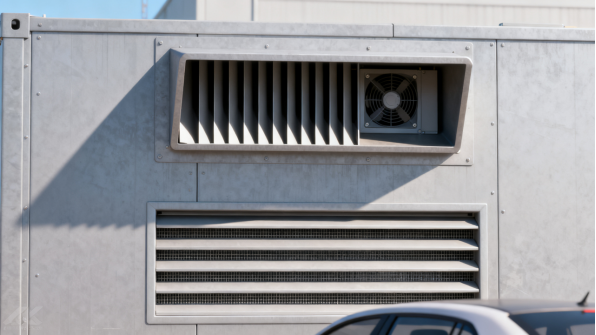
Figure 9: Thermal design: louvred filtered intake and upper exhaust grille formed into the enclosure panel.
Case 2: European Operator — DC Cabinet and Pedestal
A European charging network operator needed a floor-standing DC fast charging cabinet with a matching welded pedestal for a motorway service rollout. The unit had to meet a defined ingress standard, carry a two-colour finish, and accept a power module from a third party.
The cabinet used a welded steel frame with 2.0 mm aluminium skins, a separate power compartment, a filtered fan exhaust, and a galvanised pedestal with a gusseted base plate. Production ran at 25 pieces per batch, three batches a year, with an MOQ of 10 and FOB prices from $185 to $320 depending on configuration. First batch lead time was 32 days including galvanising and dual-colour coating, and annual value was approximately $58,000.
Case 3: Fleet Depot — Galvanised Pedestal Weldments
A North American fleet operator was retrofitting a depot and needed pedestals and base plates to mount charging units on an existing concrete apron, with anchor positions that matched the installed slab.
The weldments were produced in square section steel with laser cut base plates, gusseted corners, and a hot dip galvanised finish, with the anchor pattern taken from a site survey. Volumes ran at 150 pieces per batch, four batches a year, with an MOQ of 50 and FOB prices from $45 to $70. The first batch shipped 22 days after approval, and annual value was approximately $52,000. Because the pedestals and the enclosures came from one factory, the mounting flange and the cabinet base matched without a site modification.
Summary and Next Steps
How to Choose an EV Charging Enclosure Manufacturer
The supplier that fits this product can form the enclosure, weld the frame and pedestal, seal and drain it, finish it, and document the result under one quality system. Ask to see a water test on a comparable enclosure and a first article report showing hole positions and flatness.
The quotation should state the material and thickness, the corrosion system with its dry film thickness, the gasket type, the hardware, and the packing grade. Match the supplier to the batch size as well: a factory built for container volumes treats a 25-piece DC cabinet order as a nuisance.
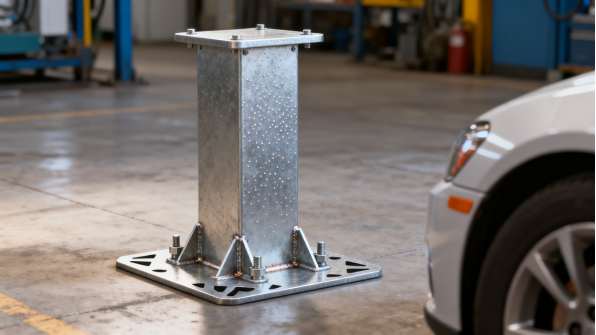
Figure 10: A galvanised welded pedestal and base plate supplied with the enclosure as one programme.
Why XHX Metal
XHX Metal provides EV charging station enclosure manufacturing from drawing to delivered parts: cutting on two 6kW fiber laser cutting machines to plus or minus 0.01 mm, CNC bending, TIG and MIG welding, deburring, powder coating and galvanising through audited partners, hardware assembly, and export packing.
The company has produced sheet metal enclosures and welded assemblies for export customers from Dongguan, Guangdong since 2014, and holds ISO 9001:2015 certification with CE documentation and SGS records. Samples in 5 to 10 working days and first batches in 15 to 30 days are normal work rather than exceptions.
How to Start Your Enclosure Programme
Send the STEP model or the dimensioned 2D drawing, the enclosure format, the installation environment, the ingress and impact requirements, the colour and finish, the annual volume and batch size, and the documents you need. If the unit is in service and no drawing exists, send photographs and key dimensions, and we will produce a reverse-engineered drawing for approval.
We reply with a manufacturability review and a quotation, and a prototype follows in 5 to 10 working days after drawing approval. Programmes are handled through the contact page.
FAQ: EV Charging Station Enclosure Manufacturing
Do you make the charging electronics?
No. We fabricate the enclosure, pedestal, brackets, and mechanical parts; the modules, controllers, connectors, and firmware are supplied by you.
Can you meet a specific ingress protection requirement? Yes, if the requirement is stated at quotation, including the test method. We build to the design, run a water test on the first article, and record the result so later batches can be compared against the same standard.
What is the minimum order?
Typically 20 to 50 pieces for a wall-mounted AC enclosure and 5 to 10 pieces for a floor-standing DC cabinet, and formats can be combined inside one programme. Pedestals, base plates, and mounting hardware can be supplied with the enclosure.
How long does a sample take?
A prototype follows in 5 to 10 working days after drawing approval, and the first production batch ships 15 to 30 days after sample approval.