Last updated: October 8, 2026 | By XHX Metal Engineering Team
Enclosure cost is decided long before a quotation arrives. By the time a price reaches a buyer, the sheet thickness, the flat pattern, the bend count, the welding, the hardware, the finish, the batch size and the packing have already set most of it. XHX Metal builds custom enclosures, cabinets and welded assemblies in a 2,000 sqm factory in Dongguan, China, and this article explains what an enclosure cost is made of instead of quoting one number.
It is written for buyers and engineers comparing quotations that do not look alike, and for anyone who needs to know which parts of an enclosure cost can be negotiated and which cannot. Every figure below is a band rather than a price list, because real enclosures vary too much for a table to be honest. Case data follows the volume and price bands used across this site.
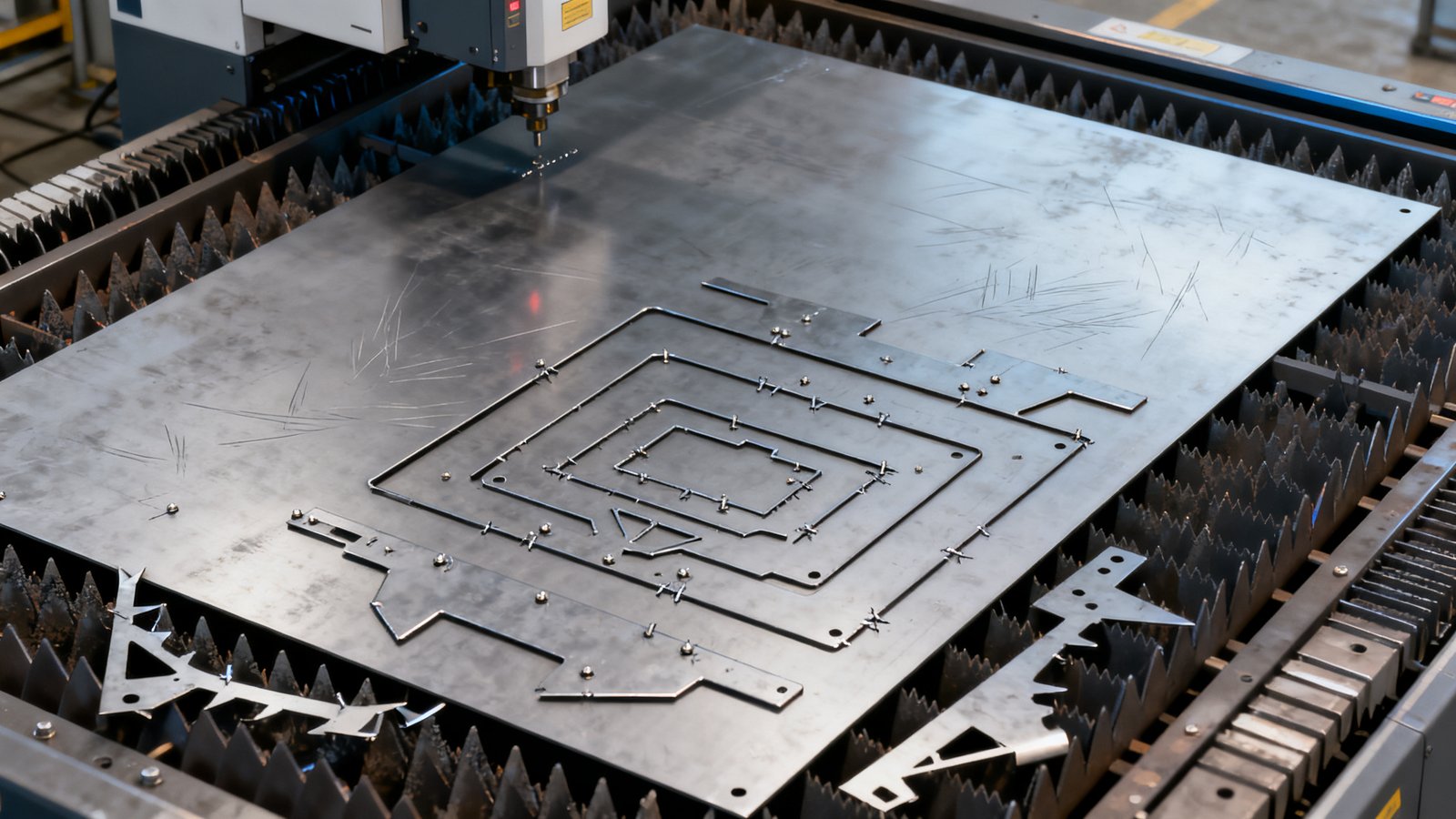
Figure 1: Nested flat blanks on a cutting bed, the point where material utilisation is decided.
Enclosure Cost: What the Number Is Made Of
Nine Elements Behind Every Line
What is actually inside an enclosure cost? Nine elements: material, cutting, forming, welding, hardware and inserts, surface finishing, assembly, packing, and the engineering and inspection that hold the parts together. Add freight, duty and the supplier’s margin and the total is complete. Material and finishing carry the largest share on a painted steel enclosure; process time takes over on welded or polished work.
Which element dominates depends on the parts ordered. Industrial cabinets, welded frames and bases, wall mounted boxes, parcel boxes and small formed panels each load the price differently. A welded cabinet with a lockable door is machine-time heavy, a flat pierced panel is material heavy, and a mirror-polished trim is labour heavy. The FABRICATOR covers how these shop-floor economics work in practice.
Fixed Setup Versus Running Cost
Enclosure cost splits into two halves. Setup is paid once: programming, a welding fixture, a bend program, a colour reference panel, a first article inspection. Running cost repeats with every unit: material, machine time, hardware, coating and packing. Small batches carry a large share of setup per unit, which is why the same box at 20 pieces and at 200 pieces is not the same product economically.
Laser cutting and CNC punching change that arithmetic. Cutting needs no dedicated die, so a first order can be small without tooling being amortised into the unit. What remains is programming, fixture and inspection, and all of it is reusable on the next batch.
What Buyers Ask When They Compare Enclosure Cost
Three questions come up in almost every enquiry: why is this quote higher than the last one, what happens to the enclosure cost if the batch doubles, and which single change would save the most without altering the design intent? All three have the same shape of answer, because the drivers are material utilisation, batch size, tolerance and finish.
We answer with a drawing review rather than a discount. The review flags a cut-out that forces a second operation, a bend that needs a special tool, a tolerance tighter than the function needs, or a finish that takes three passes. Programmes that act on it usually find 4-6% between the first and second batch.
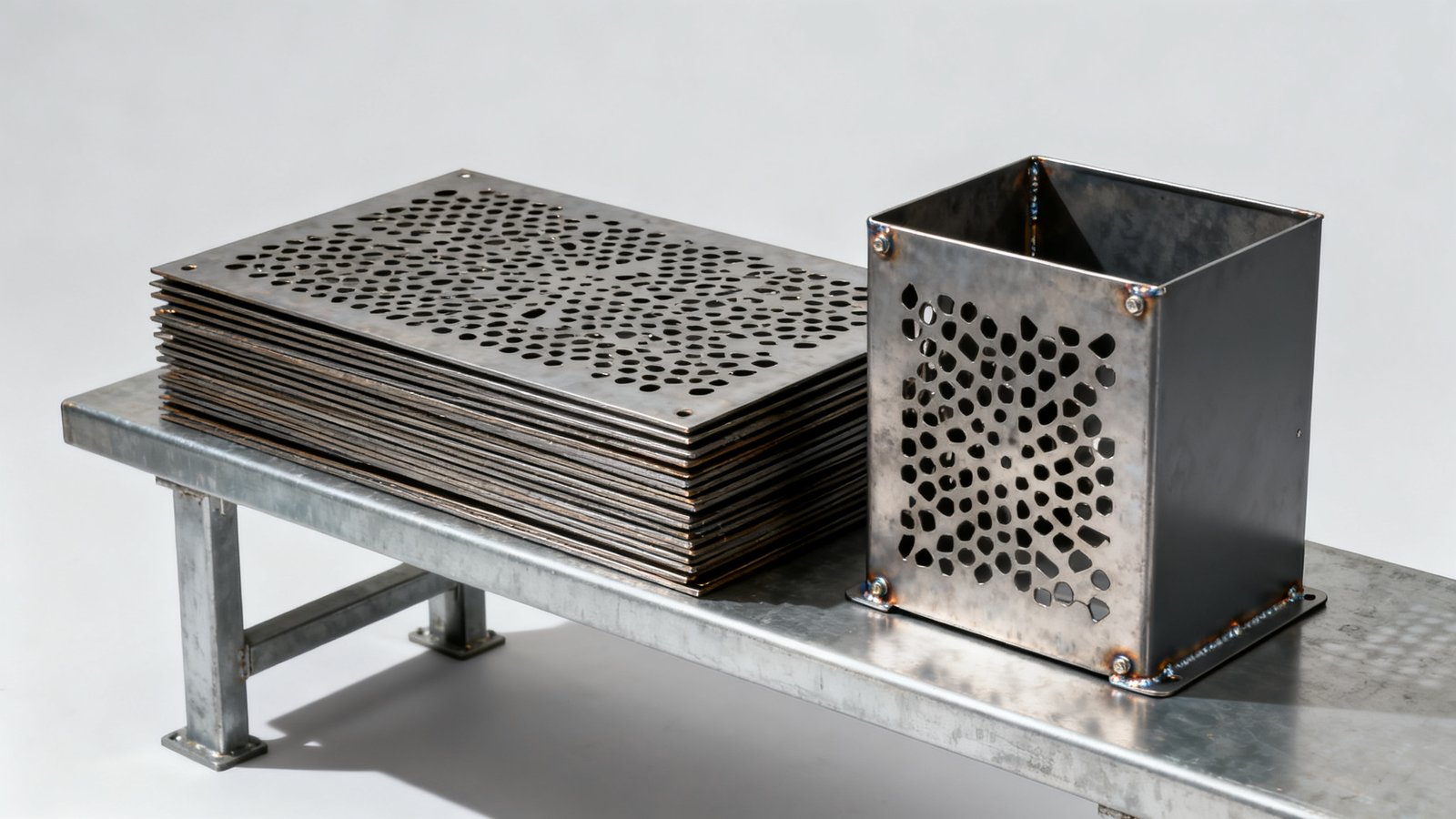
Figure 2: Flat pierced panels beside a formed and welded enclosure: the same steel, very different process time.
How Different Enclosures Carry Different Cost
Industrial Equipment and Automation Cabinets
Industrial cabinets and control enclosures sit in the middle of the range. They are usually 1.2 mm to 2.0 mm cold-rolled steel, powder coated, with a door, a gasket face, a mounting plate and cable entries. Enclosure cost here is driven by the number of bends and welds, the door fit, and how much hardware has to be installed before shipping.
Buyers in this group often add rails, shelves, fan trays and plinths to the same order. Each addition is a small enclosure cost on its own, and quoting them separately from the cabinet makes the comparison between suppliers much easier later.
Power, Battery and Outdoor Enclosures
Battery cabinets, charging hardware and roadside or pole mounted boxes are heavier and more weatherproof, and the enclosure cost reflects that. Thicker sheet, welded seams rather than folded joints, gasket channels, drip edges and a galvanised or heavy powder coat finish all add material and process time. North American specifiers set the requirements through NEMA enclosure types.
These parts are also expensive to move. Weight drives packing cost, crate cost and freight, so a buyer comparing enclosure cost between two suppliers should compare the delivered total rather than the ex-works number.
Home, Retail and Lifestyle Metal Products
Parcel boxes, letterboxes, small covers and decorative parts carry a different cost profile. Material is thin, the forms are simple, and the money goes into finishing and appearance: mirror or brushed stainless steel, colour-matched powder coat, laser-cut patterns, protective film and retail-ready packing.
For these products the price is dominated by labour and packing rather than machine time, which is why small decorative parts rarely become cheaper through automation. Volume helps mainly by improving nesting efficiency and spreading the finishing setup.
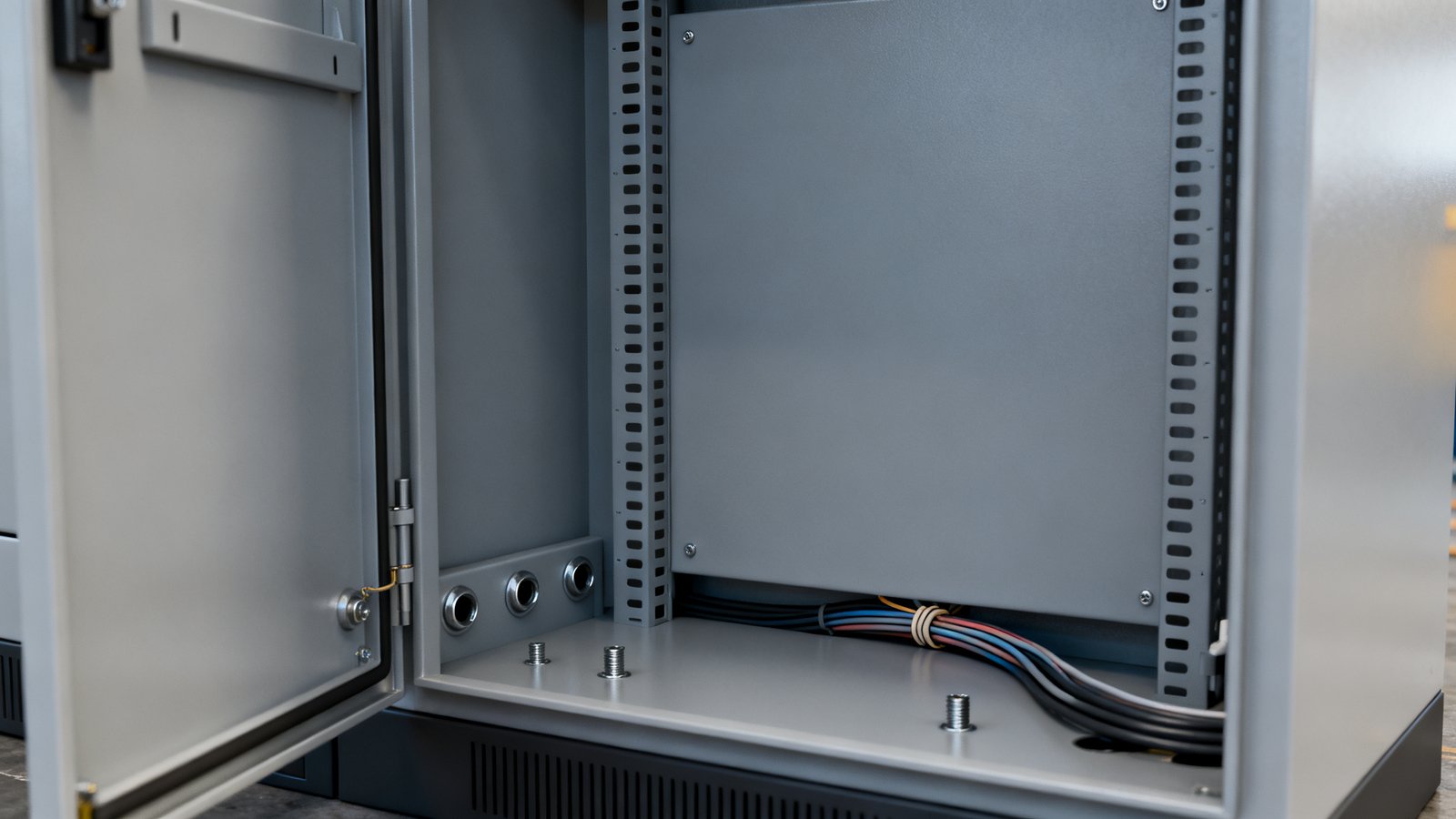
Figure 3: Inside an industrial cabinet: mounting plate, perforated rails, cable entries and installed hardware.
Material, Thickness and Finish: The Biggest Levers
Sheet Thickness and Grade
Thickness is the first lever on enclosure cost, and the easiest one to get wrong. Going from 1.0 mm to 1.5 mm cold-rolled steel increases the material bill by roughly half, and it also stiffens the part so fewer internal ribs are needed. Grade matters too: 304 stainless steel costs several times more than cold-rolled steel, and 316 costs more again. Grade background is published by the American Iron and Steel Institute and the Nickel Institute.
The useful question is what the enclosure has to survive: indoor equipment, a coastal site, or a wash-down area. Answering that first usually removes one grade step from the price without any loss of life.
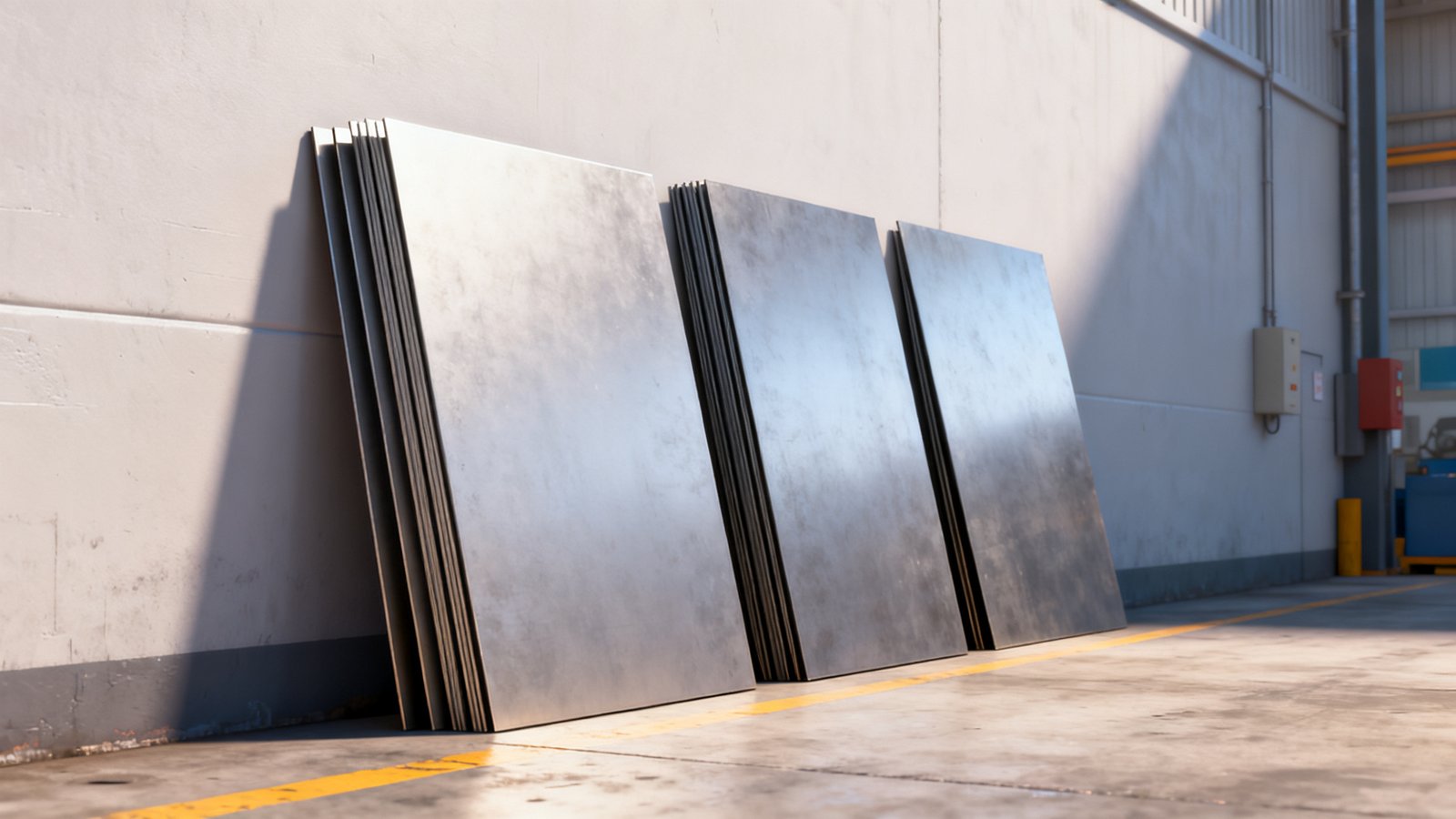
Figure 4: Sheet in three thicknesses, the single decision that moves material cost and stiffness most.
Nesting and Material Utilisation
Material utilisation is the quietest large item in the price. A part that nests at 80% on a standard sheet wastes a fifth of the steel, and the offcut cannot be sold back at the price it was bought. Nesting several parts for the same customer onto one sheet, or adjusting a blank by a few millimetres, is often the cheapest saving available.
Design also decides utilisation. Panels sized to a standard sheet divide evenly, while a shape that falls just over a half-sheet boundary can force a whole extra sheet per batch. That is one reason we review the flat pattern before quoting, not after.
Powder Coating, Galvanising and Polished Finishes
Finishing is priced by area, by preparation and by the number of passes. A single-colour powder coat over pre-treated steel is the baseline; galvanising, passivation, two-tone coating and mirror polishing each add a step. The American Coatings Association publishes background on coating performance testing.
Cosmetic requirements drive the price more than buyers expect. A part that must show no handling mark needs protective film, separate handling and slower assembly, and the cost of that discipline is real even though the drawing does not change.
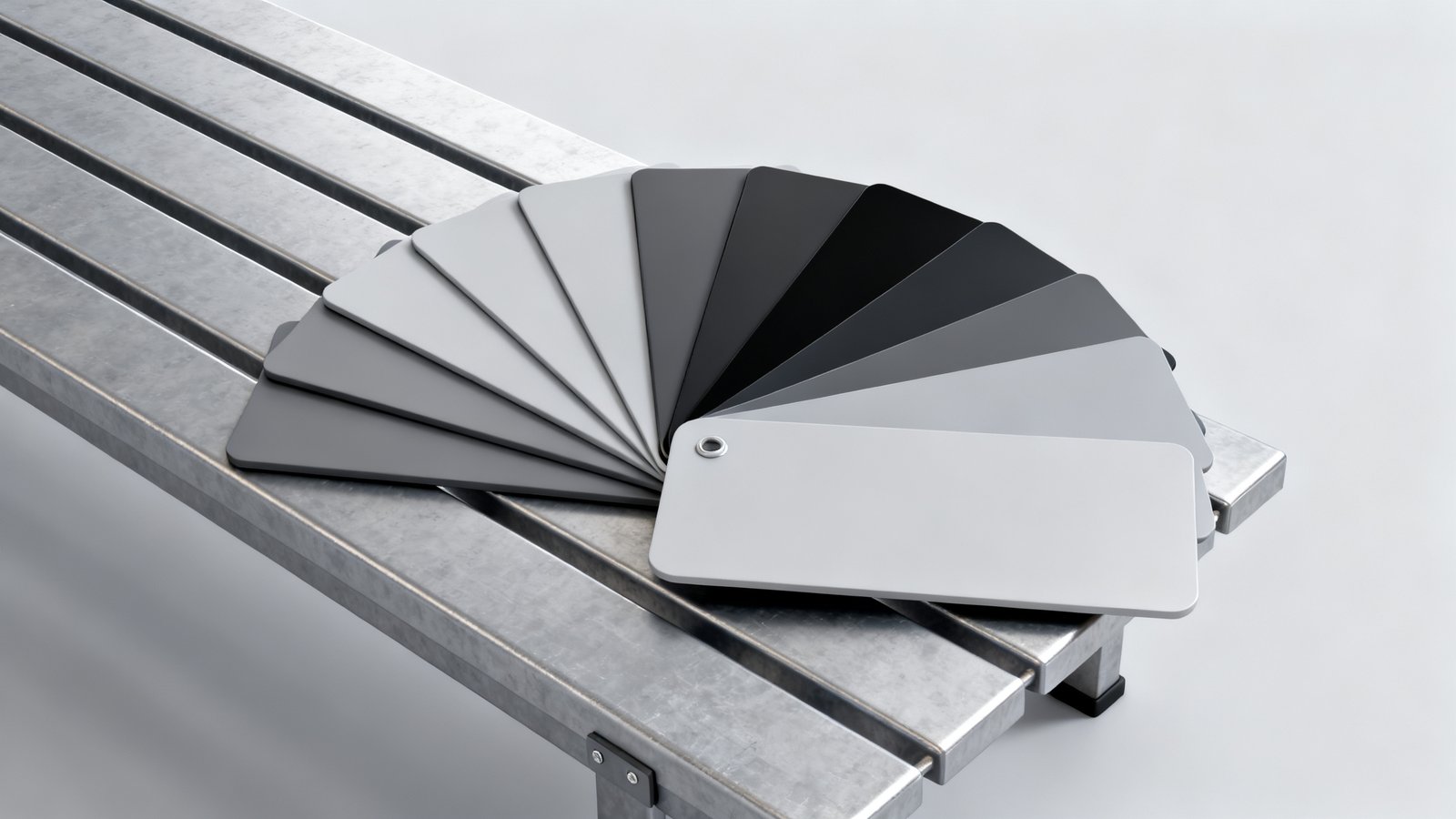
Figure 5: Coated colour reference panels, held for batch-to-batch colour matching.
What Adds Cost, and What We Do About It
Welding Distortion and Rework
Where do costs appear that were not in the quote? Welding distortion is the usual first answer. Heat shrinks a seam as it cools, a frame pulls out of square, and the enclosure cost then includes straightening, re-machining or a remake. On a welded cabinet this is the single largest source of unplanned work.
The countermeasures are known: a welded fixture for anything produced more than once, a balanced tack sequence, back-step welding on long seams, and a squareness check on a surface plate before finishing. All of them are paid for in setup, and all of them reduce the enclosure cost per unit in any batch above a handful.
Tolerances, Fixtures and Inspection
Tolerance is a price dial. A cabinet door that has to close against a gasket with a consistent gap needs a fixture and a first article inspection, and that work is part of the price. General tolerances in line with ASME Y14.5 practice are usually enough; tighter requirements are quoted against the drawing.
Inspection follows the same logic. Material certificates, a first article report and batch dimensional records are included, and third-party inspection through SGS is arranged when the buyer needs it.
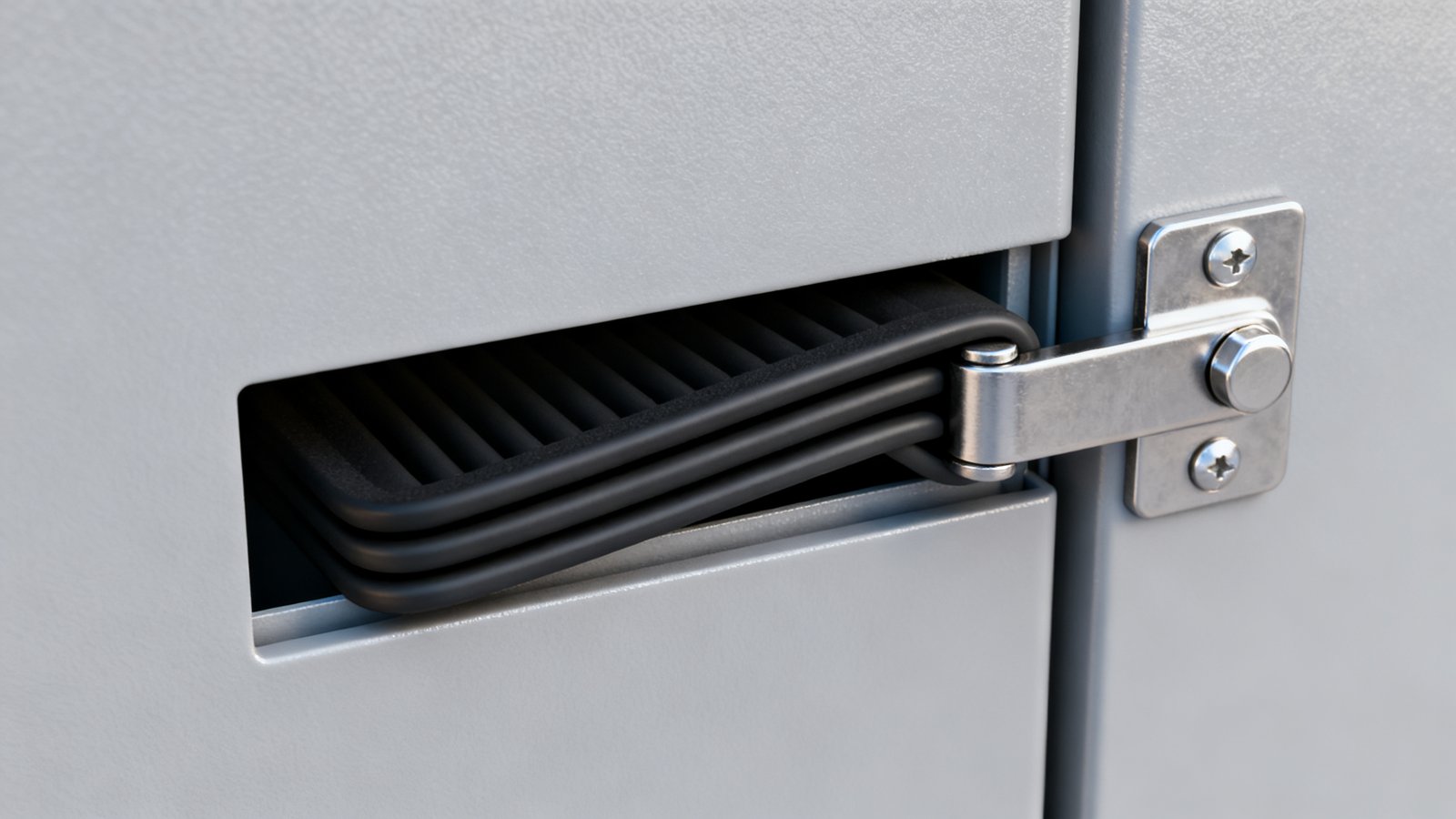
Figure 6: Door edge with a compression gasket and hinge, the detail that decides whether a cabinet seals.
Cosmetic Surfaces, Packing and Freight Damage
The most expensive defect is the one that arrives damaged. A powder coated door that rubs against another door in transit turns a finished unit into a claim, and the replacement carries the freight both ways. Packing is therefore designed per part, not chosen from a shelf.
For large cabinets that means edge protection, foam separation and a braced crate; for small polished parts it means protective film, individual bagging and a box that does not allow movement. Buyers who specify packing once, correctly, usually pay less across a programme than buyers who save on the carton.
Volume, Files and How Enclosure Cost Steps Down
Minimum Order and Batch Size
How much does volume move an enclosure cost? Batch size changes the setup share, not the material share, so the curve is steep at the start and flat later. In this factory small parts start at about 100 pieces and run 200-800 per batch; mid-size enclosures start at 20-50 pieces and run 50-300 per batch; large cabinets start at 5-10 pieces and run 10-40 per batch.
The practical version for a buyer is simpler: at the low end of a band the price is dominated by setup, and doubling the batch usually removes more than a tenth of the unit price. Beyond the band, the saving is small enough that storing a year of stock is rarely worth the cash.
What You Send Us
To price a part accurately we need a STEP model with a dimensioned 2D drawing, or a clear PDF with the critical dimensions. Quantity, material, thickness, finish, hardware and the destination market complete the picture, and US buyers often check classification under the Harmonized Tariff Schedule at the same time.
What comes back is a review as well as a price. We flag anything that will not form, weld or finish cleanly, then quote the version we would build rather than the version that will fail at the first article.
Hardware, Assembly and the Documents Included
Hardware and assembly belong in the enclosure cost rather than in a separate order. Clinch nuts, studs, rivets, hinges, locks, handles, gaskets and cable glands are installed in-house, shelves and brackets are fitted, and silk screening, laser marking and custom packing run through the same order.
Documents ship with the parts: material certificates, a first article inspection report, dimensional records on critical features and batch traceability. The factory holds ISO 9001:2015 and CE, and CE marking obligations are set out by the European Commission.
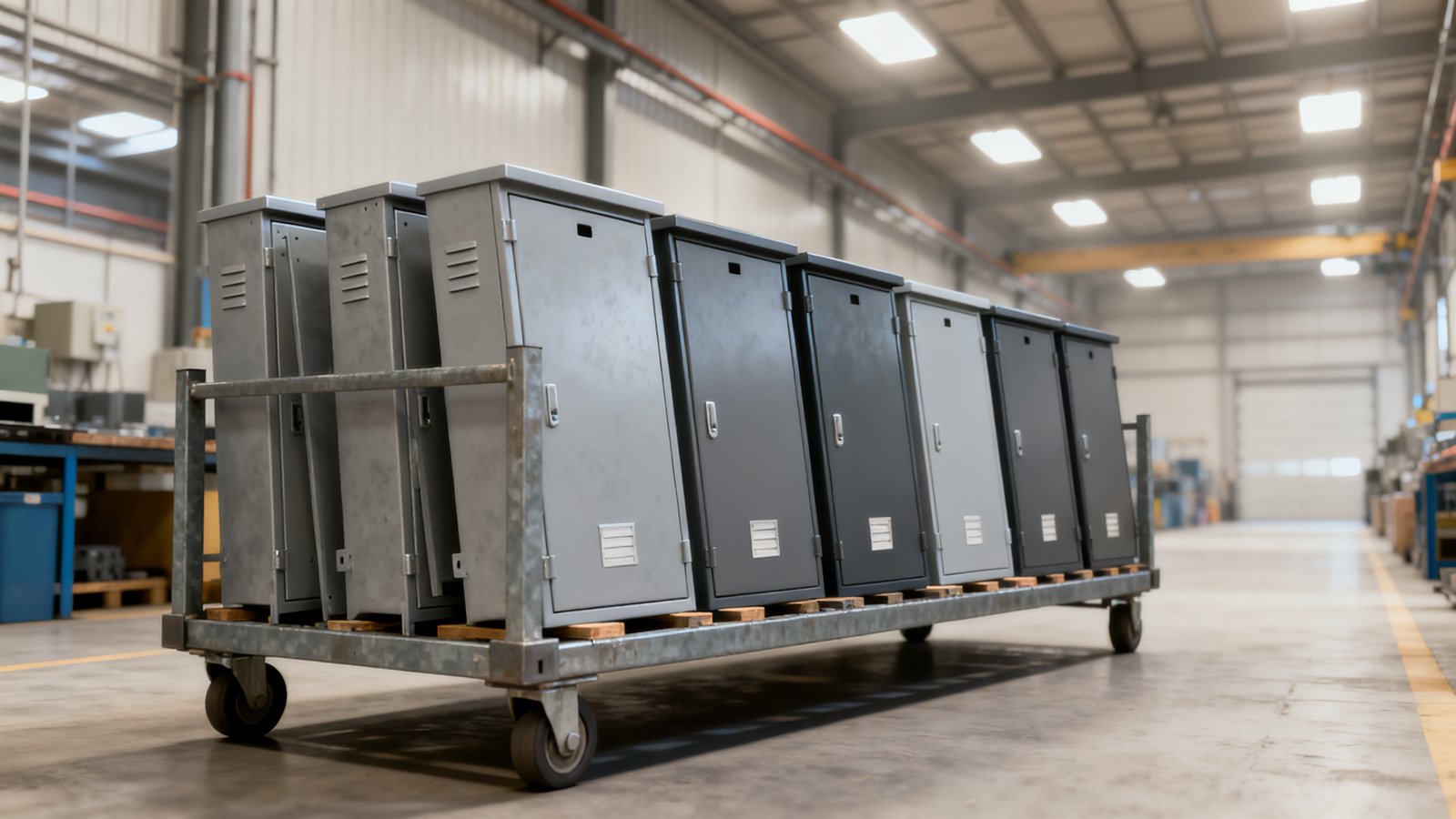
Figure 7: A production batch of identical enclosures on a rolling rack, ready for the next volume step.
Programmes: How the Cost Was Built
Case 1: Equipment Builder – Enclosure Range
An equipment builder in Europe ordered wall mounted and floor standing enclosures in 1.2 mm and 1.5 mm cold-rolled steel, powder coated to a RAL reference with a lockable door and a gasket face. Volumes ran 50-300 pieces per batch, three to six batches a year, minimum 20-50 pieces, with FOB prices in the $15-80 range per unit depending on size and door type.
The quotation was reviewed after the second batch and came down 4-6% by nesting the door and the body on the same sheet and replacing two bends with one formed return. Annual spend sat in the $30k-60k band, with SGS inspection before shipment.
Case 2: Power Equipment Builder – Floor Standing Cabinets
A power equipment builder needed floor standing cabinets in 1.5 mm and 2.0 mm steel with welded frames, gasket doors and a galvanised finish, for outdoor installations. Batches of 10-40 units, two to four times a year, minimum 5-10 pieces, with FOB prices between $100 and $400 per unit.
Weight drove the extra items: a braced export crate and palletised delivery added a visible share to the delivered price, and moving two cable-entry slots to a single formed opening removed one operation. Annual spend landed in the $25k-70k band.
Case 3: Home Brand – Small Enclosures and Panels
A home and lifestyle brand bought small covers, brackets and mirror-polished trims: 200-800 pieces per batch, four to eight batches a year, minimum 100 pieces and FOB prices from $2 to $15 per piece, with the first batch shipping 15-25 days after a sample round.
Here the price was mostly finishing and packing. Protective film, individual bagging and a fixed grain direction were specified at sample stage, and annual spend stayed in the $15k-40k band with a 4-6% step down after the first year.
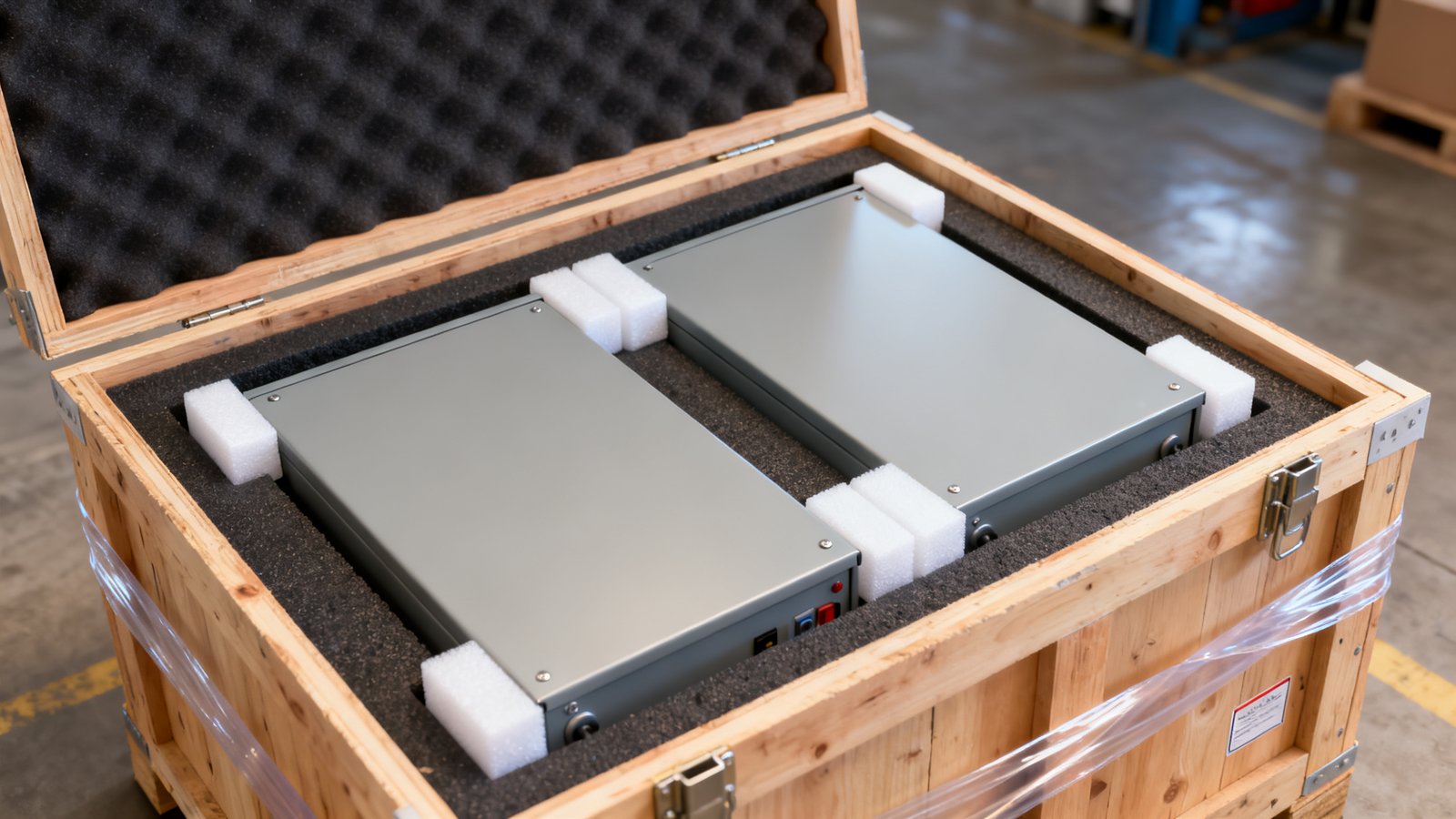
Figure 8: An export crate with foam-lined slots, edge protection and strapping for coated enclosures.
Reading a Quotation: Summary and Next Steps
How to Compare Two Enclosure Cost Quotes
Two quotations are only comparable when they describe the same part. Check the thickness and grade, the finish and colour, the hardware, the packing, the inspection, the shipping term and the batch size: most price differences are differences in scope, not in efficiency.
Then ask what happens at the next volume step, and which change would reduce the enclosure cost without changing the function. A supplier that answers both in writing knows its own floor. Manufacturing cost structures are covered by NIST MEP.
Why XHX Metal
XHX Metal keeps the whole chain in one 2,000 sqm factory in Dongguan: two 6kW fiber laser cutting machines with +-0.01 mm positioning accuracy, CNC punching, CNC bending, TIG and MIG welding, deburring, CNC machining, finishing and assembly. That is what allows a price to be quoted with setup and running elements separated.
Samples follow in 5-10 working days, the first batch ships in 15-30 days, and cutting carries no die cost. The company has exported to North America and Europe for over a decade, holds ISO 9001:2015 and CE, and runs 500,000 parts a year.
How to Start Your Programme
Send a STEP model or drawing with the quantity, finish and destination market. What we build is set out on the sheet metal capabilities page, finished parts are on the products page, and quoting starts from the contact page; project enquiries also go to sales01@xinghaoxin.com.
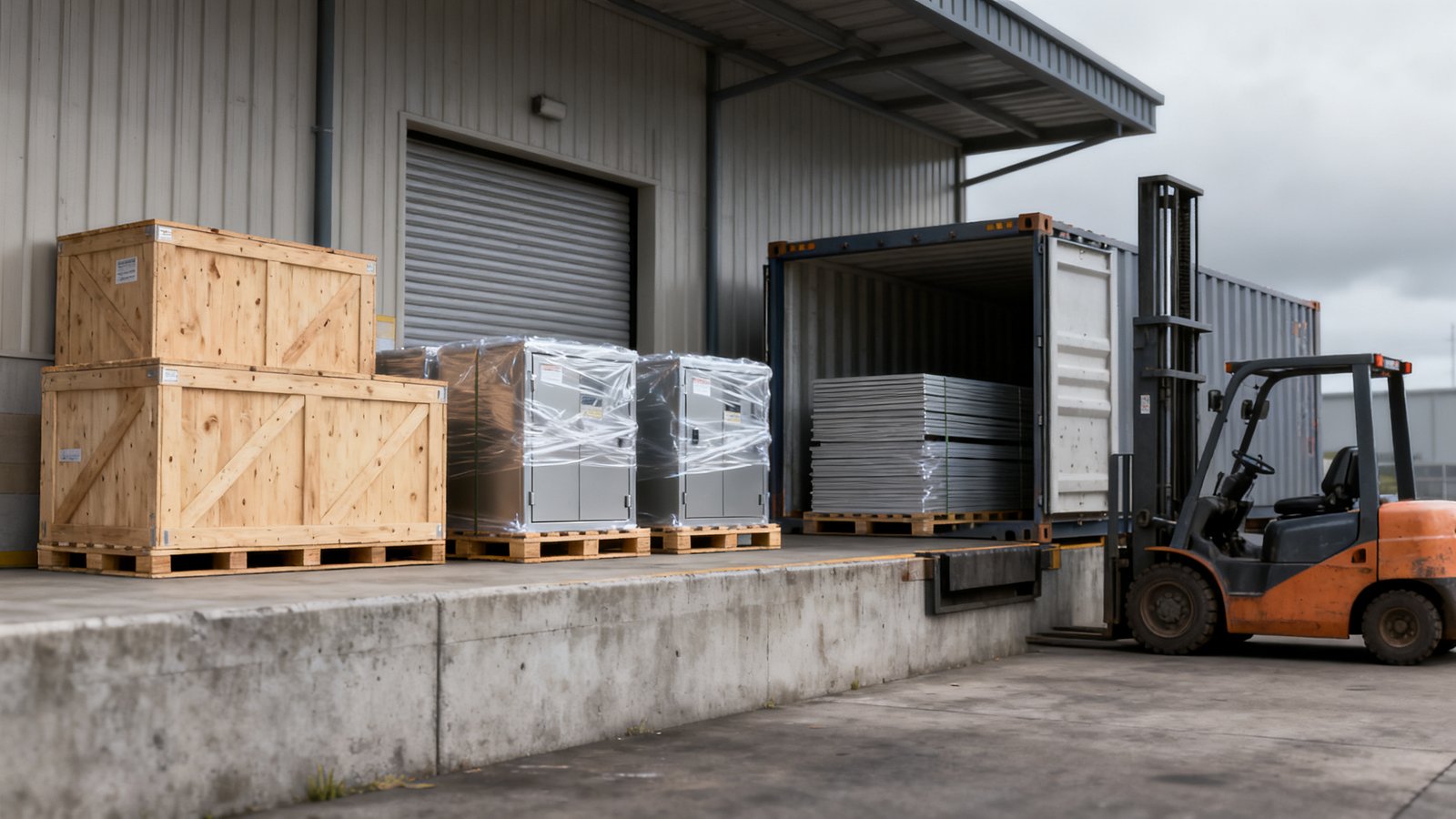
Figure 9: Export crates and pallets on a loading dock, where packing and freight enter the total.
FAQ: Enclosure Cost
What drives enclosure cost the most? Material utilisation, batch size, tolerance and finish. On a painted steel box the sheet and coating dominate; on welded or polished parts, process time does.
How much does a bigger batch save? Doubling a small batch usually removes more than a tenth of the unit price, because the setup is spread further. Savings flatten once the batch sits inside its size band.
Why is a Chinese quote sometimes lower? Labour and material rates are part of it; the rest is scope. Check thickness, finish grade, hardware, packing and shipping term before comparing totals.
Can you quote before the drawing is final? Yes. A STEP model or a marked PDF is enough to price the concept, and the review flags what to change early.