1. Product Overview: What Custom Industrial Equipment Enclosures Are
1.1. Defining the Product Family
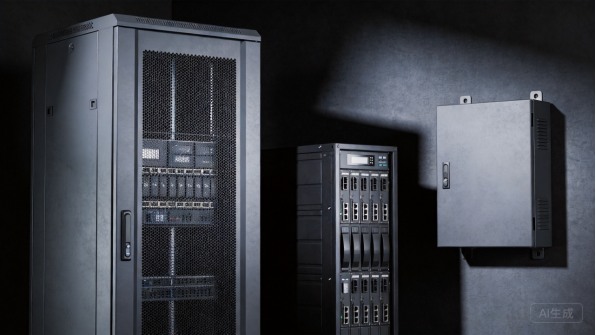
An industrial equipment enclosure is a fabricated metal housing that protects electrical, electronic, pneumatic, and mechanical components inside a machine, production line, power distribution network, or standalone device. It keeps people away from live parts, keeps dust and water away from sensitive components, supports mounting plates and cable entries, and gives the finished product a professional, consistent appearance. In sheet metal terms, the family includes floor-standing control cabinets, wall-mount boxes, machine housings, operator consoles, junction boxes, EMC housings, battery cabinets, and outdoor kiosks. The same engineering logic applies to all of them: cut and form flat sheet metal into accurate panels, join them into a rigid frame, add doors and hardware, and finish the surface for the environment where the equipment will live.
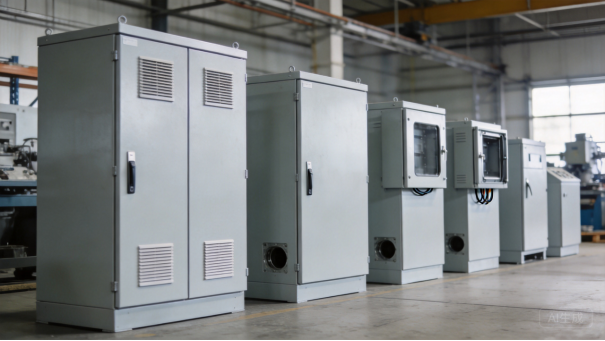
Custom sheet metal equipment enclosures in floor-standing, wall-mount, and machine-housing configurations.
1.2. Anatomy of an Enclosure
Most enclosures are built from the same vocabulary of parts. A typical cabinet has a back panel, two side panels, a top, and a base, plus one or more doors with hinges and locks. Inside, a mounting plate or DIN rail carries the components, while cable glands, bushing plates, and knockout cutouts bring power and signal cables through the walls. Ventilation is handled by louvers, filtered fans, vents, or heat exchanger openings, and sealing is handled by gaskets, folded seams, and weld seams. Grounding studs, earth bonding points, and conductive coatings connect every panel to the protective earth. A small wall-mount box may contain twenty fabricated parts; a large outdoor cabinet with doors, gaskets, mounting plates, cable management, and accessories can contain more than two hundred.
1.3. From Standard Box to Custom System
Standard enclosures solve standard problems, but most buyers need custom sizes, cutouts, door styles, and layouts. Custom fabrication starts with a 3D model and 2D drawing: overall dimensions, panel thickness, door opening direction, mounting plate position, cable entry locations, louver and fan cutouts, display and button openings, lock types, color, texture, and silkscreen markings. The manufacturer converts the drawing into flat laser-cut patterns, bends them into shape, welds or fastens the frame, and finishes the surface. Design for manufacturability (DFM) review is where a good fabricator earns its keep, because it catches details that are cheap to change on paper and expensive to change after cutting: bend radii, hole-to-edge distances, weld access, gasket groove sizes, and tolerances that the material can actually hold.
1.4. Why Quality Is Judged the Moment an Enclosure Arrives
The enclosure is the first thing an installer touches and the last thing a product team controls, so its quality is judged immediately. Doors must open smoothly and close without rattling, panels must line up with consistent gaps, hinges and locks must work after years of use, and the powder-coated surface must survive tools, forklifts, and weather. Dimensions matter even more: if the mounting plate holes are out of position, the customer cannot assemble its own electronics; if door cutouts are oversized, gaskets leak and IP ratings fail. Tolerances that look simple on a drawing, such as 0.5 mm on mounting points or 0.2 mm on hinge spacing, become real challenges across cutting, bending, welding, and coating.
1.5. Customization and the OEM Partner Model
Customization is also a business model. OEM and ODM brands bring their own control systems, software, or branding, and need a metal partner that can produce enclosures in their color, with their cutouts, and on a schedule that matches product launches. XHX Metal, the English brand of Guangdong Xinghaoxin Technology Co., Ltd., is a privately owned sheet metal company in Dongguan with a 2,000-square-meter factory, about thirty production staff, two 6 kW fiber laser cutting machines, CNC bending and welding, an automatic deburring line, CNC machining, and an annual capacity of about 500,000 parts. The company produces and processes sheet metal enclosures for automation, power, telecom, medical, and general industrial equipment. The sections below explain how enclosures are used, which materials fit which jobs, why production is harder than it looks, what a realistic lead time is, and what past projects teach.
2. Usage Characteristics: How Enclosures Perform in the Field
2.1. Factory Floors and Production Lines
On a factory floor, an enclosure is a working station, not a cabinet in a clean office. PLCs, drives, relays, power supplies, and terminal blocks live inside panels placed next to machines, where vibration, dust, oil mist, temperature swings, and occasional washdown water are normal. The enclosure must stay square so doors seat properly, keep liquids away from terminals, and let maintenance staff reach components quickly. A machined or welded frame resists vibration better than a light folded box, and gasketed doors prevent dust from accumulating on contacts. Cable entries should match the actual conduit or gland system used on site, because a customer that has to drill holes in the field usually damages the coating and voids the protection class.
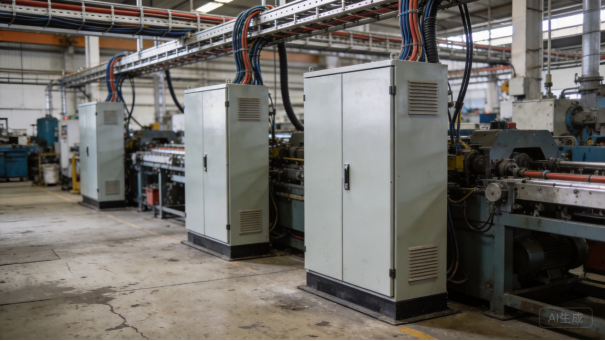
Powder-coated steel enclosures installed beside production equipment on a real factory floor.
2.2. Power Distribution and Electrical Rooms
Power distribution creates different demands. Switchgear and control cabinets carry busbars, breakers, contactors, meters, and cables that run warm and can arc in fault conditions. The enclosure must provide electrical separation, clear warning space, adequate ventilation or cooling, and barriers that meet local electrical safety practice. Indoor electrical rooms are usually cleaner than production floors, but the equipment runs continuously, so heat buildup is a constant problem. Designers specify vented doors, roof fans, or air-conditioned enclosures for high-power panels, and they locate cable entries so cables do not bend against sharp edges. The finish must also be flame-resistant and stable at operating temperature, which is why industrial enclosures are commonly powder coated rather than left with bare or painted metal.
2.3. Automation, Telecom, and Data Infrastructure
Automation and communication systems add signal integrity, grounding, and cable management to the list. Variable-frequency drives generate heat and electromagnetic noise, so enclosures for drives often include cooling fans, EMC shielding, and careful separation of power and signal cables. Network and telecom equipment needs structured cable routing, patch panel cutouts, and racks or shelves inside the cabinet. Grounding is not a detail: every door, panel, and internal rail should be bonded so touch voltages stay low and electromagnetic compatibility improves. Some customers specify conductive or EMC coatings inside, gaskets at door seams, and filtered ventilation to reduce radiated interference. For these projects, the enclosure design must be coordinated with the customer’s electrical drawing, not designed in isolation.
2.4. Outdoor and Harsh Environments
Outdoor enclosures carry the heaviest usage requirements. They face sun, rain, salt air, temperature swings, insects, and sometimes vandalism, so protection class, gasket material, hardware, and finish all move up a level. Common specifications are IP54 to IP66 per IEC 60529, with gasketed doors, stainless or plated fasteners, drainage weeps, and sunshades for direct-sun applications. Galvanized or stainless steel is used where corrosion is severe, while aluminum suits coastal sites that need lighter weight. UV-resistant powder coating keeps color from fading, and captive screws or padlockable latches protect access. A field failure outdoors is expensive to fix, so the usage envelope should be written into the spec before material and finish decisions are made.
2.5. Turning Usage into Specification
The practical lesson is that usage should be written down before fabrication. Ask where the enclosure will be installed, whether it is indoors or outdoors, how hot and humid the site is, whether washdown or salt exposure occurs, how much heat the components produce, how cables enter, which side technicians need to open, and what protection class the final product must claim. Each answer changes the design: an indoor machine housing can use simple vents, while an outdoor telecom cabinet needs gaskets, filtered fans, and stainless hardware. When usage is clear at the drawing stage, material, process, and lead time choices become easier, and the delivered enclosure performs the way the buyer expected.
3. Material Selection: Choosing the Right Sheet Metal for the Job
3.1. Cold Rolled Steel: The Workhorse
Cold rolled steel is the workhorse of industrial enclosure fabrication. Rolling at room temperature produces a smooth surface, consistent thickness, and good dimensional accuracy, which makes it ideal for precision bending and painted products; grades such as SPCC and DC01 appear across panels, doors, and frames. It has high strength and excellent formability, so it can be bent into complex profiles without cracking, and it welds cleanly with standard MIG, TIG, and laser processes. Its weakness is corrosion: bare cold rolled steel rusts quickly, so every part must receive full pretreatment and powder coating, and scratches through the coating need touch-up. For indoor equipment that is painted, it is usually the best balance of performance and cost.
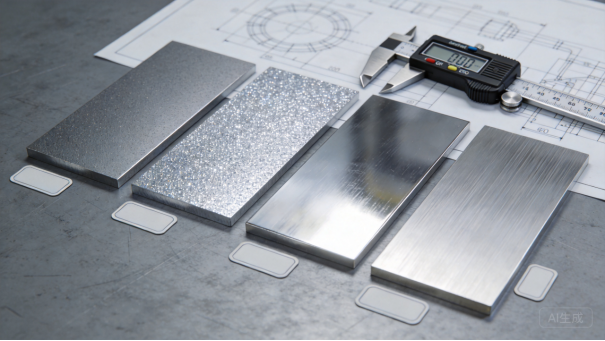
Steel, stainless, and aluminum material samples with thickness measurement tools.
3.2. Galvanized and Pre-Painted Steel
Galvanized steel is steel protected with a zinc layer, usually by hot-dip galvanizing, and it is chosen when corrosion resistance matters more than a perfectly smooth painting surface. It is common for internal brackets, back plates, outdoor back panels, and enclosures that will receive a second powder coat. Fabrication needs care: sharp bends can crack or flake the zinc, so bend radii should be generous; welding produces zinc fumes and needs ventilation, and weld zones should be cleaned and re-coated. Pre-painted steel is an alternative for simple parts, where the factory buys coil or sheet already painted in the required color and skips the finishing line, but cut edges still need edge protection or touch-up in outdoor service.
3.3. Stainless Steel: Selective Upgrades
Stainless steel serves the harshest environments. Grades 304 and 316 form a self-healing chromium oxide layer that resists moisture, chemicals, and salt, and 316 adds molybdenum for coastal, food, and pharmaceutical duty. It is heavier, harder to cut and bend, and more expensive, so it is used selectively: outdoor coastal cabinets, washdown equipment, food processing lines, medical devices, and visible hardware such as hinges, locks, and fasteners. Stainless also work-hardens, so tooling and bend radii must be matched to the grade. The price difference is usually justified when field failure would be expensive, but unnecessary stainless raises cost without adding value in a dry indoor environment.
3.4. Aluminum: Lightweight and Corrosion-Resistant
Aluminum takes the opposite path: it weighs about one-third as much as steel, resists corrosion naturally, and forms and welds well in alloys such as 5052 and 6061. It is popular for portable equipment, battery housings, power electronics, and enclosures that must be lifted, wall-mounted, or shipped economically. Aluminum conducts heat better than steel, which helps in some thermal designs, and it is naturally conductive, which supports grounding and EMC performance. The trade-offs are lower strength at the same thickness, softer surfaces that scratch and dent more easily, and higher sensitivity to heat during welding. Because aluminum is usually specified thicker than steel, the final weight advantage is real but smaller than the density difference suggests.
3.5. Gauge, Finish, and Cost
Sheet thickness is the second dimension of material selection. Small wall-mount boxes are typically 1.0 to 1.2 mm, machine housings 1.2 to 1.5 mm, and floor cabinets 1.5 to 2.0 mm, while mounting plates and heavy structural parts go to 2.0 to 3.0 mm or more. Stiffness comes from bend profiles, flanges, and gussets as much as from gauge, so a good designer lets geometry carry strength and uses heavier metal only where load, door weight, or IP sealing requires it. The finish completes the decision: zinc phosphate pretreatment plus polyester powder coating is the standard for indoor industrial enclosures, while outdoor designs may need primer, UV-stable color, conductive internal coating, or salt-spray testing. Cost should always be compared on finished parts, because density, scrap, processing time, and finishing change the final price.
4. Production Difficulty: Precision, Heat, and Tolerance Control
4.1. Laser Cutting: Where Precision Begins
Production starts with laser cutting. XHX Metal uses two 6 kW fiber laser machines that cut panels, doors, and brackets with positioning accuracy around 0.01 mm, nesting parts to save material and producing edges that still need deburring. The cutting stage is the foundation of the whole product: if a mounting hole is out of position on the flat pattern, the error carries through bending and assembly and can turn a good-looking cabinet into scrap. Cut quality also affects appearance, because laser-cut edges are visible on doors, vents, and openings. Cutting speed must be balanced against edge roughness, dross, and heat-affected zone, especially for stainless and aluminum, which behave differently from carbon steel.
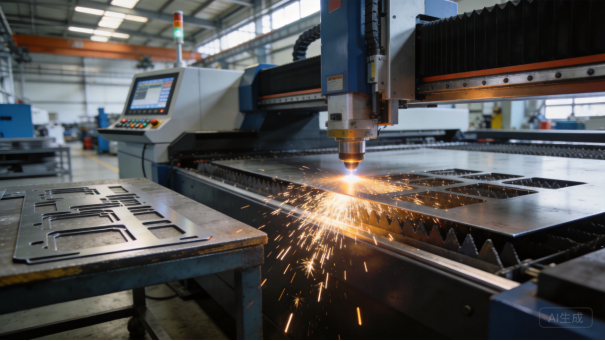
Fiber laser cutting of enclosure panels from steel sheet.
4.2. CNC Bending: Angles and Repeatability
CNC bending turns flat patterns into three-dimensional panels. The press brake operator must account for bend allowance, springback, material thickness, grain direction, and tooling radius, and the machine must repeat the same angle across the whole batch. A bend that is 0.3 degrees off changes the gap between a door and its frame; a bend radius that is too tight cracks galvanized coating or stress-marks stainless. Because enclosures depend on folded edges for stiffness, door frames, and gasket seats, bending is one of the highest-value processes in the shop. First-article checks include flange length, bend angle, hole-to-bend distance, and overall squareness, and every shift verifies the setup before running the batch.
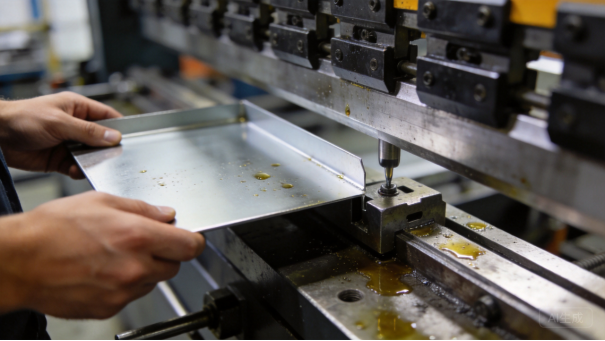
CNC press brake forming a sheet metal enclosure panel.
4.3. Welding and Distortion Control
Welding is the highest-risk step in enclosure production. Frames, mounting plates, and reinforcing gussets are joined with TIG, MIG, or laser welding, and heat always tries to distort the metal; long panels are especially sensitive because welding one side can pull the whole structure out of square. The solution is controlled process: dedicated jigs, tack welding, a defined weld sequence, and alternating sides so heat balances. XHX welds joints in a fixed order, then checks diagonals and squareness of every frame. Aluminum needs even more care because it conducts heat quickly and softens near the weld, so welding current, filler material, and cooling are controlled. If a frame is not square after welding, no finishing process can fix it.
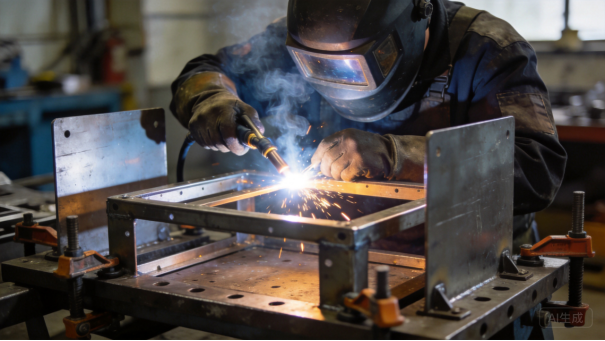
TIG welding and frame assembly on a dedicated jig.
4.4. Fastening, Assembly, and Hardware
Assembly adds another layer of precision. Mounting plates and DIN rails are fixed with weld nuts, PEM fasteners, rivets, or bolts, and every threaded point must be positioned so the customer’s components fit without shimming. Doors hang on hinges that must align with the frame, locks must line up with strike plates, and gaskets must sit in their grooves without bulging. Grounding continuity must exist across every metallic panel, which means bonding straps, star washers, or conductive coatings in the right places. Some enclosures add EMC finger stock, filtered vents, and captive fasteners. A one-millimeter error can make a door rattle or a gasket leak, so hardware fit is checked as carefully as sheet metal dimensions.
4.5. Coating, Masking, and Inspection
Finishing makes the difficulty visible. Powder coating adds a durable layer, but it also changes dimensions: coating around threaded holes, grounding points, and gasket grooves can prevent hardware from fitting, so those areas are masked and parts are hung to avoid pooling in corners. Pretreatment quality determines long-term adhesion, and film thickness, color, and texture are checked against the spec. After coating, every batch is inspected for dimensions, door fit, surface quality, and hardware function. XHX performs first article inspection on every new design and full inspection on visible and functional features, and documents results so a batch can be traced back to its material certificate. Production is also a scheduling problem: cutting is fast, bending is medium, welding is slow, and finishing is the bottleneck, so orders are sequenced so panels flow without waiting.
5. Lead Time: From Drawing to Shipped Enclosure
5.1. Realistic Timelines
Lead time is usually the second question a buyer asks, after price, and it has the most variables. A completely new enclosure design typically needs four to eight weeks from approved drawings to delivered production, including a first article. A repeat order of an established design can ship in two to four weeks. The real schedule depends on the design, material, finishing process, order quantity, and shipping method, so the stages below give a practical breakdown instead of a single magic number. Buyers who start with a complete drawing and a clear approval process consistently receive their enclosures faster than buyers who begin with a rough sketch.
5.2. DFM Review and Material Procurement
The cycle starts with design review and quotation. When XHX Metal receives a 3D model and 2D drawing, the engineering team checks material, thickness, bend radii, hole patterns, tolerances, finishes, hardware, and IP requirements, and flags anything difficult to produce; this DFM review takes one to three working days. Material procurement follows, with standard cold rolled steel, galvanized steel, and common aluminum alloys available from local suppliers in one to three working days. Special orders, such as stainless steel with mill certificates, custom pre-painted coil, or exotic alloys, take longer. Because metal prices move, the quotation carries a material validity period, and the specification should be frozen when the order is placed.
5.3. Prototype and First Article
Prototyping comes next. For a new enclosure design, XHX produces a first article within one to two weeks after material arrives, including laser-cut and formed panels, welded and deburred frames, and usually a trial powder coat so the customer can verify dimensions, color, texture, and fit. Special bending tools, forming dies, or welding jigs add a few days to two weeks. The customer’s approval of the first article is the green light for production; changes requested at this stage extend the timeline, which is why a complete drawing saves money and weeks. The first article report should include measured dimensions, photos, coating checks, and any deviations for approval.
5.4. Production and the Finishing Bottleneck
Mass production runs in batches. For 50 to 1,000 enclosures, production usually takes one to three weeks depending on process count and finishing capacity. The factory sequences cutting, bending, welding, deburring, and surface treatment so parts flow without waiting, and QA checks the first and last parts of each shift to catch drift early. Two laser cutters and multiple press brakes mean one maintenance event does not stop an order. Powder coating is the bottleneck: cleaning, pretreatment, spraying, and curing take longer than cutting and bending, and masking for threaded holes and grounding points adds hours. The scope matters too, since some buyers take raw parts while others receive fully assembled cabinets with doors, hinges, locks, mounting plates, gaskets, and grounding kits.
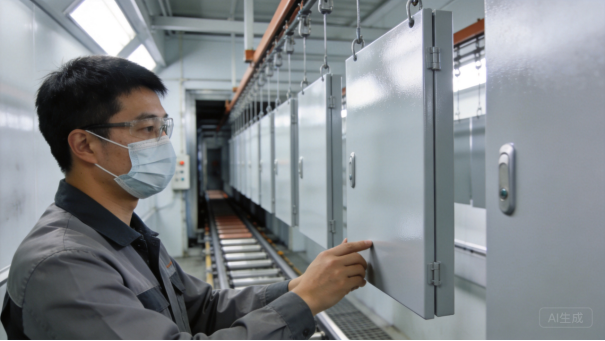
Powder-coated enclosure panels on the finishing line.
5.5. QC, Packaging, and Shipping
The final days are quality control and packaging. XHX inspects dimensions, squareness, door fit, and surface quality, prepares packing lists and material certificates, and protects enclosures with corner protectors, film, and bracing so they survive freight. From Dongguan, air freight to North America or Europe takes about three to seven days, while sea freight to a major port takes three to five weeks plus customs and inland delivery. The company’s on-time delivery record is 93.1 percent on the Alibaba international platform. Practical advice for buyers: freeze the design, approve the first article quickly, and order spare doors, gaskets, or mounting plates with the main run, because a small reorder later costs much more.
6. Past Cases: Enclosure Projects We Have Built
6.1. How to Read These Cases
Project examples show how usage, materials, production difficulty, and lead time come together. Because customer confidentiality is part of XHX Metal’s service, the cases below are described without brand names, but they represent real enclosure projects produced by the company in recent years, with quantities and timeframes taken from actual order records. The projects cover different regions, industries, and finishing systems to show how the same process adapts. Names, drawings, and internal details are protected, but the engineering lessons are shared because they help new buyers ask better questions.
6.2. Case 1: Control Enclosures for a European Automation Integrator
A European automation integrator needed floor-standing control cabinets for packaging machines, with a 2.0 mm steel frame, 1.5 mm doors and panels, filtered fan cutouts, and a custom RAL color. The previous supplier delivered frames that twisted during welding, so doors did not align and the integrator spent hours adjusting hardware on site. XHX redesigned the frame with corner gussets, changed the welding sequence to balance heat, and added a squareness check on the assembly fixture. The first article was approved in nine working days, and 600 enclosures shipped over six weeks. The customer reported that assembly time dropped noticeably because doors, hinges, and mounting plates fit without adjustment.
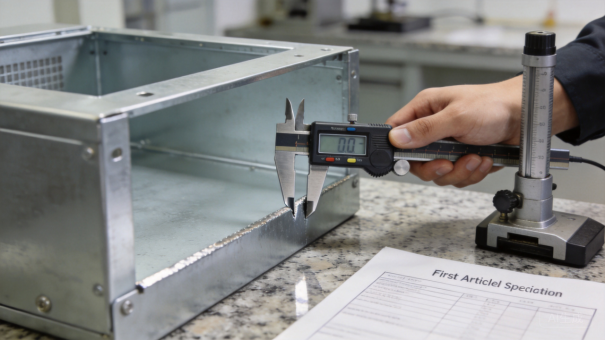
Final dimensional inspection of a finished enclosure before shipment.
6.3. Case 2: Outdoor Telecom Enclosures for Southeast Asia
A telecom contractor deploying equipment in a humid tropical market needed outdoor enclosures rated IP55, with gasketed doors, filtered vents, and corrosion-resistant hardware. The site environment included heavy rain, high humidity, and salt in coastal areas, so XHX specified galvanized steel for the frame and internal parts, stainless fasteners, and a UV-stable powder coat with thicker film at the base. The pilot batch passed humidity and salt-spray testing, and about 1,200 units shipped in three batches over eight weeks. Packaging was standardized for tropical freight: corner protectors, moisture-resistant film, and pallet bracing cut transit damage, and smaller wall-mount units were nested to save container space.
6.4. Case 3: Aluminum Enclosures for a Power Equipment OEM
A power equipment OEM needed lightweight aluminum enclosures for portable generator control panels, with good thermal performance and natural conductivity for grounding. XHX selected 5052 aluminum with formed flange profiles for stiffness, controlled the weld sequence to limit distortion on thin panels, and applied a light-texture powder coat for outdoor use. The design review simplified several internal brackets, which reduced weight and cut production time. About 800 enclosures shipped in monthly batches, and the customer reused the same frame geometry for three product sizes by changing only door and panel cutouts.
6.5. Case 4 and the Lessons We Reuse
A machine tool brand wanted a family of enclosures from small junction boxes to large operator cabinets with the same finish, hinges, locks, and grounding scheme. XHX standardized the hinge kit, lock, gasket profile, and mounting plate pattern across the family, which reduced tooling and cut unit cost after the first months; the brand now receives mixed orders with different heights and door options. The consistent lessons are simple: DFM review prevents assembly problems, material and finish must match the environment, welding and bending consistency makes a design repeatable, first article approval protects the schedule, and quick decisions from a private company keep projects moving. The brand also reports fewer field complaints because the standardized packaging was tested across every size in the family.
7. Summary: What to Prepare Before Starting an Enclosure Project
7.1. Start With the Engineering Package
The engineering package matters most when starting an enclosure project. It should include the 3D model and 2D drawing, material grade and thickness, protection class, door and lock style, mounting plate or DIN rail layout, cable entry points, vent and fan cutouts, finish color and texture, grounding requirements, packaging method, and target volume. Even a short DFM checklist answered in one email can save a week of back-and-forth later, because fabrication decisions depend on details that are cheap to change on paper and expensive to change after cutting. Before sending files, list the questions that matter most: operating environment, maximum internal heat, cable routing, and access side are usually enough to start.
7.2. State Standards and Finishes
Standards should be explicit. Most enclosure projects reference IEC 60529 for IP ratings, ISO 9001:2015 for quality management, and industry-specific electrical safety rules, but the buyer must confirm the exact rating, test conditions, and finish specification. The drawing should define powder coating color, film thickness, texture, masking points, and grounding continuity. If the enclosure will live outdoors or in a coastal area, the material and finish specification must be upgraded before fabrication, not after a field failure. A one-line note about the environment prevents the most expensive mistakes, and a written salt-spray or humidity test requirement gives both sides a clear acceptance criterion.
7.3. Agree on the Commercial Package
The commercial package is equally important. Confirm the delivery incoterm, inspection standard, payment schedule, material validity period, and rules for design changes. Ask for a first article schedule, a production capacity statement, and a list of certifications. ISO 9001:2015, CE, and SGS verification are useful signals, but the practical proof is how quickly the supplier answers a drawing question and how carefully it documents a batch. A supplier that explains its process is easier to trust than one that only promises a date. Written confirmation of the delivery date, inspection points, and packaging standard prevents disputes once the order is in production.
7.4. Why Work With XHX Metal
XHX Metal suits this kind of project because it is a privately owned company with production control in one place. The owner and engineering team can approve tooling changes, discuss material substitutions, and agree on a realistic delivery date without passing decisions through a distant headquarters. The factory has two 6 kW fiber laser cutters, CNC bending and welding, an automatic deburring line, CNC machining, and a 500,000-part annual capacity, which is enough for mid-volume enclosure programs and flexible enough for prototype runs. The company specializes in producing and processing sheet metal, so it understands how drawing choices, tooling, and finishing affect both quality and schedule.
7.5. The Next Step
The fastest way to start is to send your drawings and ask for a DFM review and quotation. XHX Metal can confirm the material route, finish system, production difficulty, and realistic lead time within a few working days. Contact Barry at +86 13244963694 or sales01@xinghaoxin.com, or visit https://www.xhxmetal.com. The factory is at No. 42 Changtang Avenue, Yantian, Chang’an Town, Dongguan, Guangdong, China. Industrial equipment will keep demanding smarter enclosures, tighter tolerances, better thermal design, and faster delivery, but the fundamentals stay the same: square frames, accurate cutouts, reliable doors, durable finishes, and on-time supply. That is exactly what a controlled sheet metal process delivers, and why engineering preparation, not luck, determines how fast a custom enclosure project succeeds.
About XHX Metal
XHX Metal (Guangdong Xinghaoxin Technology Co., Ltd.) is a privately owned sheet metal fabrication company in Dongguan, Guangdong, China. The company specializes in producing and processing sheet metal enclosures and parts for automation, power, telecom, medical, and general industrial equipment, with two 6 kW fiber laser cutting machines, CNC bending, TIG, MIG, and laser welding, an automatic deburring line, CNC machining, and ISO 9001:2015 quality management.
Contact: Barry | +86 13244963694 | sales01@xinghaoxin.com | https://www.xhxmetal.com