Last updated: October 20, 2026 | By XHX Metal Engineering Team
A powder coating service applies a dry polymer finish to sheet metal by spraying electrostatically charged powder onto a grounded part, then curing it in an oven until it flows into a continuous film. At XHX Metal a powder coating service runs on cut, formed and welded parts inside a 2,000 sqm factory in Dongguan, China, alongside laser cutting, CNC punching, bending and welding.
This article is written for buyers and engineers specifying a finish rather than a bare part: what a powder coating service covers, which parts and materials it suits, what decides film thickness and adhesion, what goes wrong and how it is prevented, how long the work takes, what documents prove the finish, and three order examples with volumes and price bands.
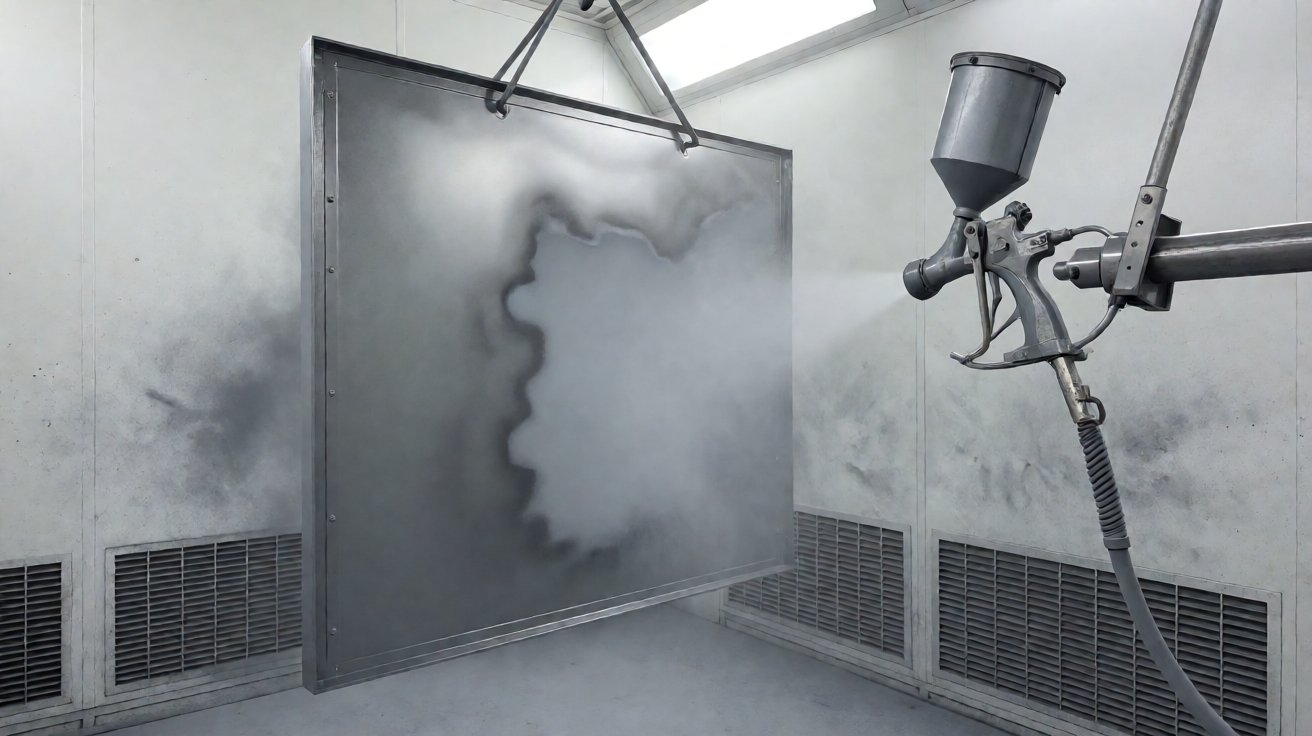
Figure 1: A powder coating service spraying a sheet metal enclosure panel inside an electrostatic booth.
Powder Coating Service: What We Provide
What the Service Covers
What does a powder coating service actually do? It does four things in sequence: pretreatment to make the metal accept the coating, application of charged powder by spray gun, curing in an oven to melt and cross-link the film, and inspection of thickness, colour and adhesion. A part that skips pretreatment will fail adhesion however well it is sprayed.
Buyers order a powder coating service either on parts we manufacture or on customer-supplied parts. Both are quoted on the same answers: substrate, part size, colour and gloss, target film thickness, masking requirements, and quantity per batch.
The parts coated most often are enclosure panels, cabinet bodies and doors, mounting plates, brackets, machine covers, chassis and louvre vent panels. One enclosure programme usually carries eight to twenty parts, and coating them as one batch keeps colour and gloss consistent across the assembly.
Pretreatment: The Step Buyers Underestimate
Pretreatment decides whether the coating stays on a powder coating service. Steel is degreased, then either phosphated or treated with a conversion coating so the powder can bond chemically as well as mechanically. Aluminium needs its own conversion treatment, and galvanised sheet needs a process that does not attack the zinc.
A powder coating service that skips or shortens pretreatment produces a finish that looks correct on the day and lifts in sheets six months later. The failure shows up as coating peeling from a bend or a sheared edge, not as a visible defect at delivery, which is why pretreatment records matter more than appearance at goods-in.
Application, Curing and Batch Control
Application in a powder coating service is electrostatic: the gun charges the powder, the grounded part attracts it, and the film builds until the part is covered. Curing then runs at a temperature and dwell time set by the powder manufacturer, typically around 180 to 200 degrees Celsius for a defined period, during which the powder melts, flows and cross-links.
Under-curing leaves a film that is soft and chemically vulnerable; over-curing yellows light colours and can make the film brittle. Both are controlled by oven records rather than by eye, which is why a powder coating service should be able to show cure logs for the batch you received.
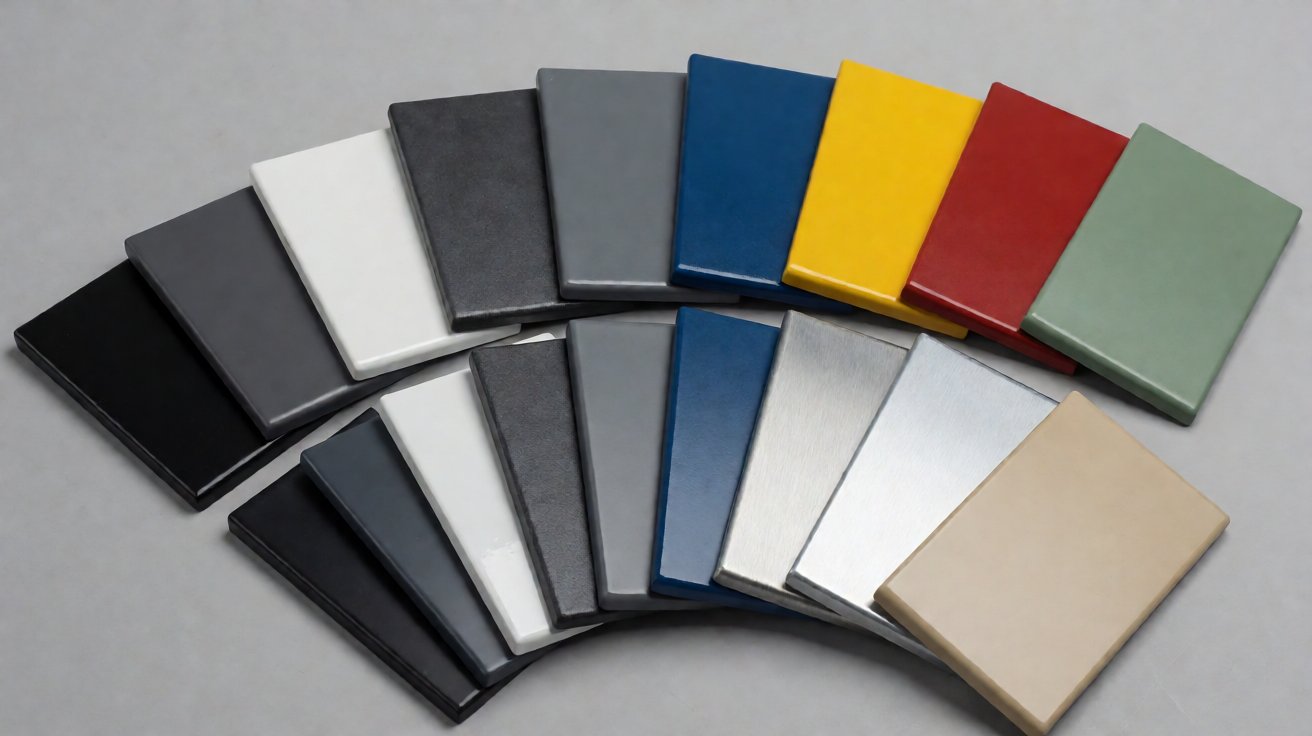
Figure 2: Powder coated colour sample coupons showing matte, satin and gloss finishes at different builds.
Where a Powder Coating Service Is Used
Electrical and Electronic Enclosures
Enclosures are the largest share of work for a powder coating service: wall-mount and floor-standing cabinets, control and distribution boxes, doors, gland plates and mounting panels. These parts are judged on colour consistency across an assembly and on coating build in corners, because a door and its cabinet have to match in daylight.
Enclosure coating also has a functional requirement that decorative work does not: earth continuity. Studs, shielding lands and mating faces are masked before coating so the assembly conducts, and that masking is agreed on the drawing rather than decided at the booth.
Machine Covers, Guards and Frames
Machine covers, guards, frames and bases are the second group a powder coating service handles. These are larger, often welded, and frequently specified in a textured or low-gloss finish that hides handling marks better than a smooth gloss film.
Welded parts need more care than flat panels because the coating has to cover weld seams and inside corners without bridging or forming a dry spot. A powder coating service that sprays a weldment like a flat panel will deliver rust bleeding through the seam within a season outdoors.
Outdoor, Street and Infrastructure Parts
Outdoor work is the third group, and the one a powder coating service must get right on corrosion: roadside cabinets, bollards, frames, signage panels and structural brackets. Here the specification is driven by corrosion life rather than appearance, so pretreatment, coating chemistry and film thickness are all pushed up, and a salt spray test result is part of the requirement.
Outdoor parts also carry the longest warranty expectations, so the coating specification is written against a corrosion category rather than a colour. That means pretreatment class, powder chemistry and film thickness are all fixed before quotation, and the test evidence is agreed at the same time.
Related assemblies are listed on the products page, and the coating process sits alongside grinding and finishing on the capabilities page.
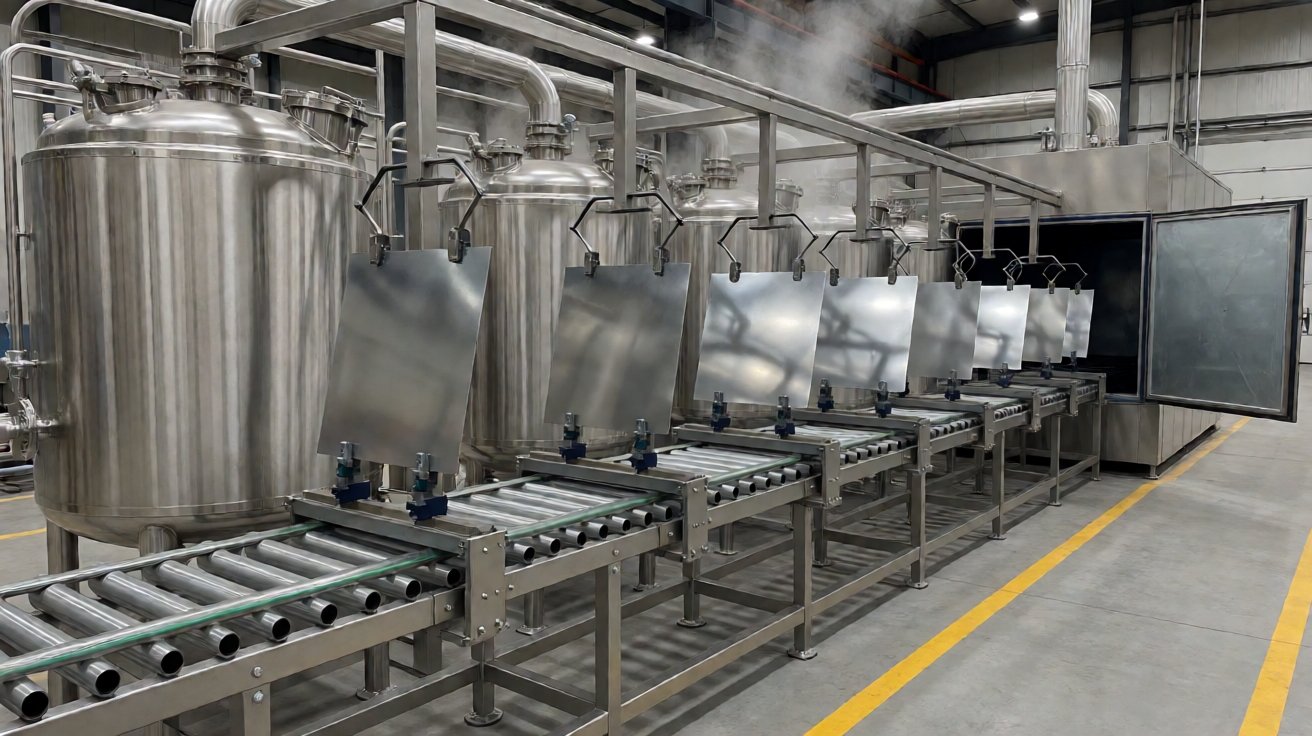
Figure 3: Powder coating service pretreatment line: process tanks and a drying oven on an overhead conveyor.
Materials, Colours and Coating Specification
Substrates and How They Behave
Cold rolled steel is the default substrate for a powder coating service and takes the powder most predictably. Hot dip and electro-galvanised steel need a pretreatment that tolerates zinc, or the coating blisters as the zinc reacts. Aluminium requires its own conversion coating. Stainless steel is rarely powder coated except for colour, because its own oxide layer already protects it.
Coating performance categories and test methods are described by ASTM International. Material practice for these grades is documented by the American Iron and Steel Institute and SSINA. Where aluminium is used, the Aluminum Association publishes the alloy and temper designations that determine how the surface responds to pretreatment.
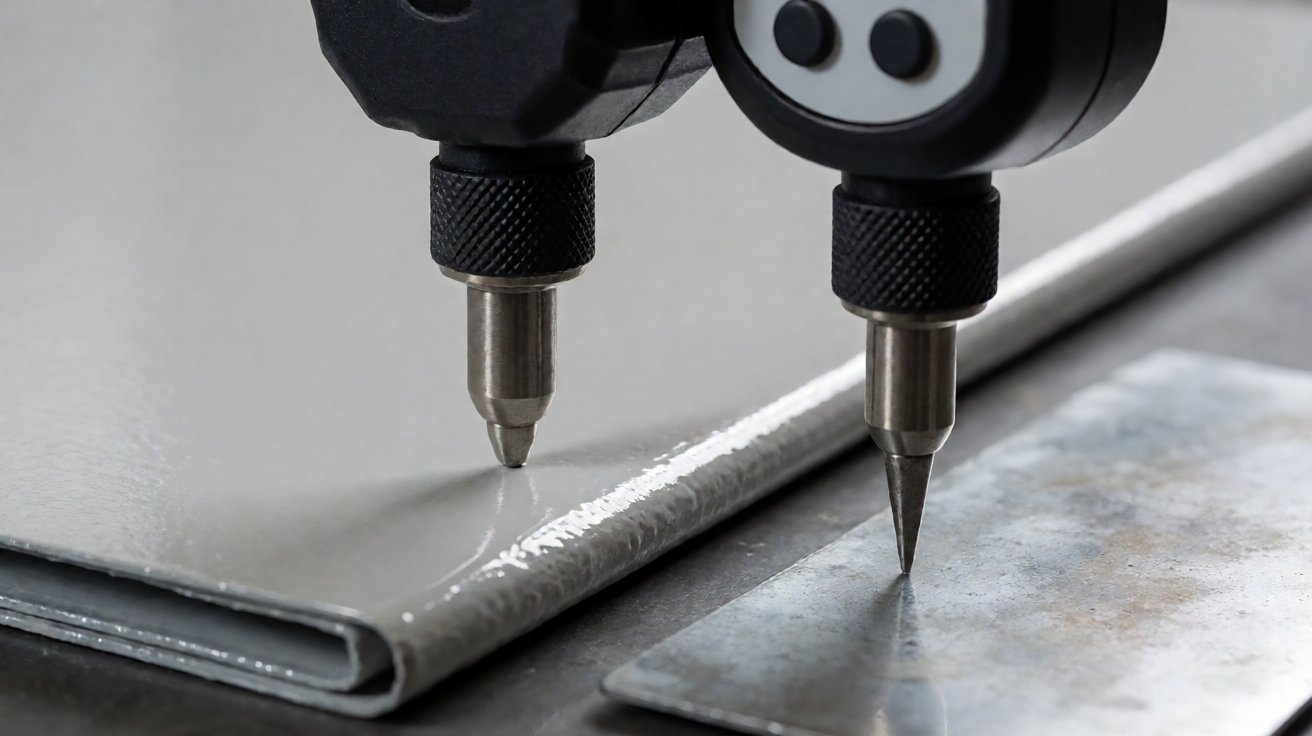
Figure 4: Film thickness measured on a powder coated panel with a magnetic coating thickness gauge.
Colour, Gloss and Texture
Colour references are held by the RAL colour system and by ISO for industrial finishes. Colour in a powder coating service is specified by a standard reference rather than by name, because a description like mid grey covers a wide range. Gloss level is specified separately and matters more than most buyers expect: the same colour in 30 gloss and 80 gloss reads as two different products under factory lighting.
Texture is the third variable and a practical one. A fine texture hides weld dressing and minor surface marks; a smooth gloss film shows every imperfection in the substrate beneath it. Specifying texture is often cheaper than specifying a better substrate.
Film Thickness and What It Costs
Film thickness is the single biggest lever a powder coating service controls on both cost and performance. Typical architectural and enclosure work sits at 60 to 80 microns; outdoor and corrosion-critical work pushes to 100 microns or more. Doubling thickness does not double protection, but it does raise powder consumption and cycle time.
Thickness also interacts with fit. A coating adds measurable build on every surface, so a tight mating face, a threaded insert or a gasket groove has to be either masked or dimensioned to allow for it. Discovering this after coating is how parts end up not assembling.
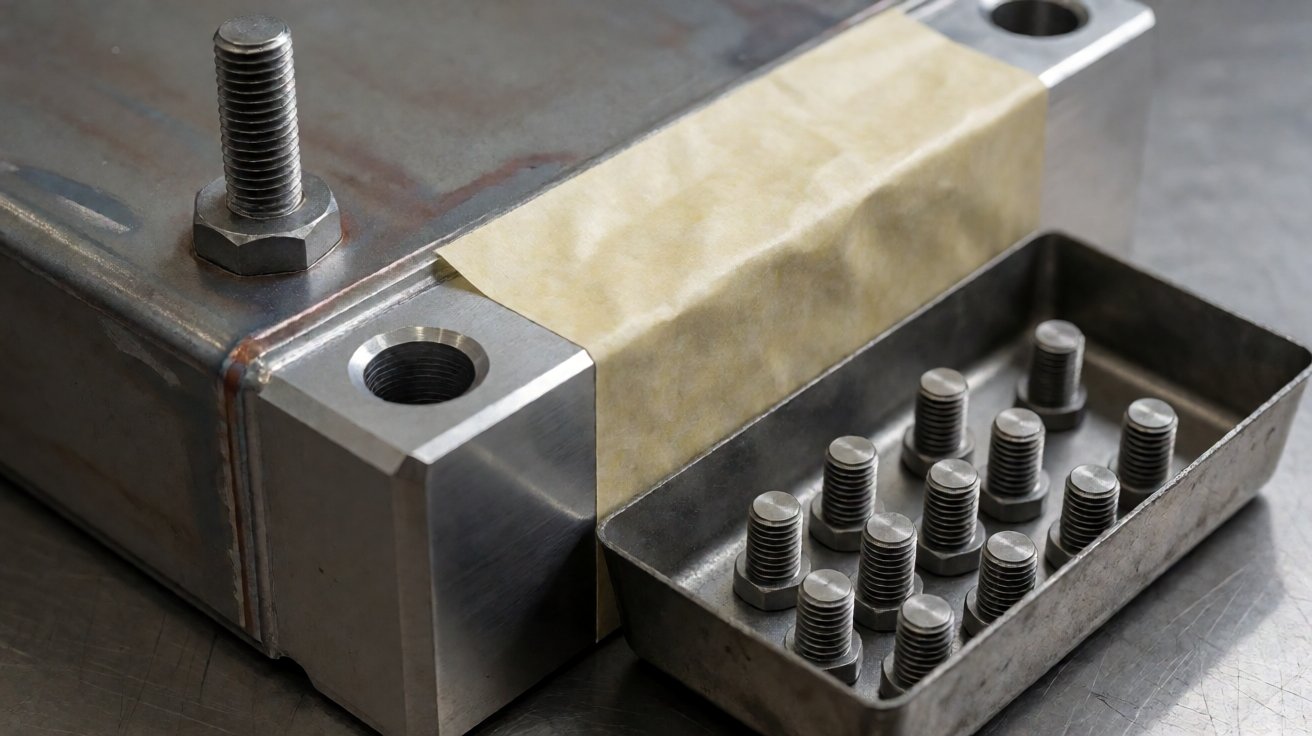
Figure 5: Masking before coating: silicone plugs in threaded holes and tape across a machined mating face.
What Makes Powder Coating Hard to Get Right
Adhesion Failure and Pretreatment Gaps
What quality risks should a buyer watch for in a powder coating service? The first is adhesion. Coating that lifts from a bend, a sheared edge or a scribe line points to a pretreatment problem, not a spraying problem, and it usually affects the whole batch rather than one part.
Our countermeasures are controlled pretreatment with recorded stage times and temperatures, a cross-hatch adhesion test on first article, and a bend test on coupons from each batch. Where a substrate is difficult, the test coupons run through the line with the production parts rather than separately.
Film Thickness Variation and Faraday Shading
The second risk in a powder coating service is thickness variation. Powder builds faster on edges and on surfaces facing the gun than in recesses and inside corners, a behaviour known as Faraday shading, so a box section can end up thin at the back and heavy on the front lip.
Countermeasures are gun angle and distance set per part geometry rather than per batch, a second pass into recesses, and thickness measurement at defined points including inside corners rather than only on the flat face. Where a part is geometry-critical, a jig is made so the spray path repeats.
Contamination, Colour Drift and Handling Damage
The third risk group in a powder coating service is contamination and consistency. Oil, dust or a fingerprint on a bare part becomes a crater or a fisheye in the cured film. Colour drifts between batches if powder lots are mixed, and gloss drifts if cure temperature is inconsistent.
Handling damage is the last and most visible risk: coated parts mark and chip, so they are separated between operations, packed with interleaving, and handled with gloves once cured. A chipped edge cannot be touched up invisibly, which is why packing is part of the coating specification and not an afterthought.
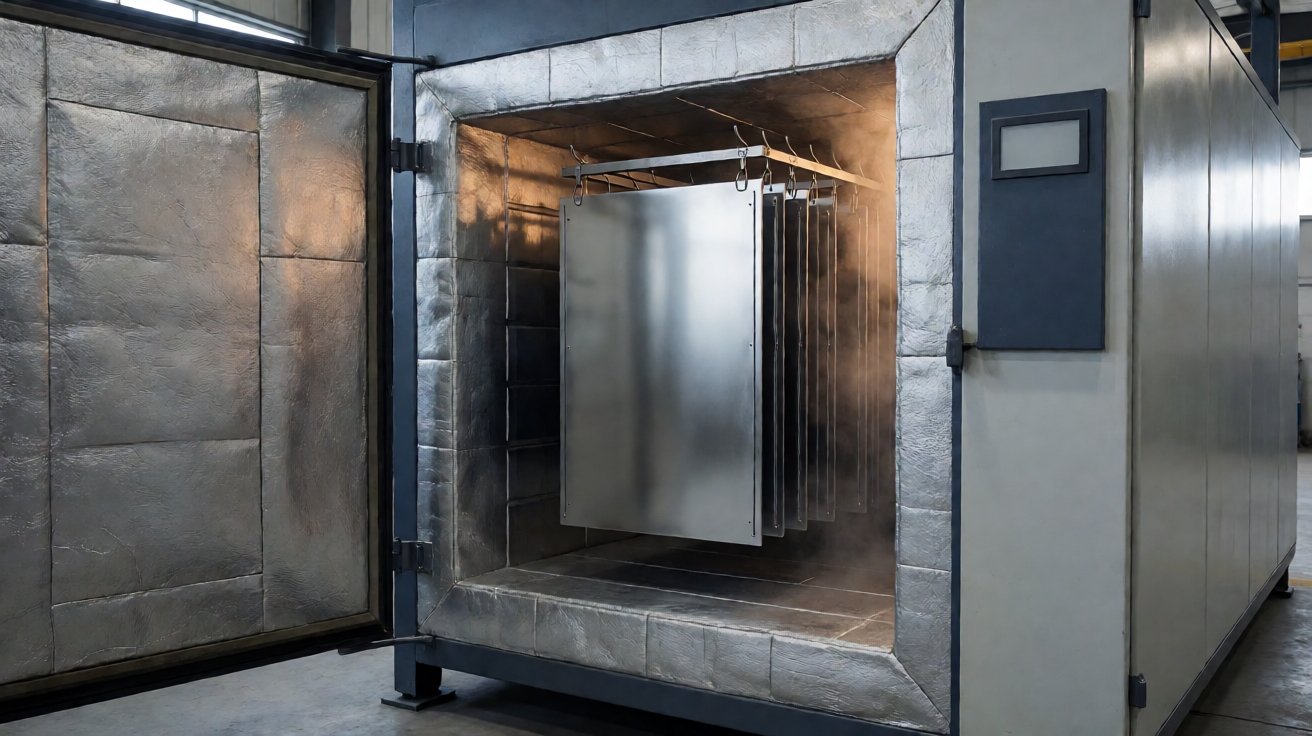
Figure 6: A batch of powder coated panels curing in an oven, the coating fully flowed out to a satin finish.
Powder Coating Service Lead Times and Documents
What to Send for a Quotation
What does a powder coating service need to quote? Send the part drawing or a sample, the substrate and its condition, the colour reference and gloss level, the target film thickness, the masking requirements, and the quantity per batch. Add whether the parts are ours or customer-supplied.
Two details change the price of a powder coating service more than buyers expect. The first is masking: every masked hole or face is hand work. The second is the number of colours in one batch, because a colour change costs setup time regardless of part count.
Where the finish is still being chosen, send a sample of the substrate and the environment the part will see. We return a specification with colour, gloss, thickness and pretreatment rather than a colour name.
Lead Times
Colour samples from a powder coating service follow in 5-10 working days after the specification is agreed, and the first production batch ships 15-30 days later depending on quantity and colour count. Coating is usually the last operation before packing, so its lead time sits at the end of the chain rather than the start.
Two things move the date: a colour that has to be ordered in, and a masking requirement that arrives after the parts are formed. Both are cheaper to settle before the batch reaches the booth.
Inspection, Certificates and Test Evidence
Documents ship with the parts: film thickness readings at defined points, a cure record for the batch, a colour and gloss confirmation, and adhesion test results. Where the specification requires it, salt spray results are provided from a test panel run through the same line.
Corrosion testing practice is described by NACE International. The factory holds ISO 9001:2015 and CE, and third-party inspection can be arranged through SGS or by a customer visit. Coating test methods are published by ASTM International, and for export orders US buyers calculate landed cost with the Harmonized Tariff Schedule.
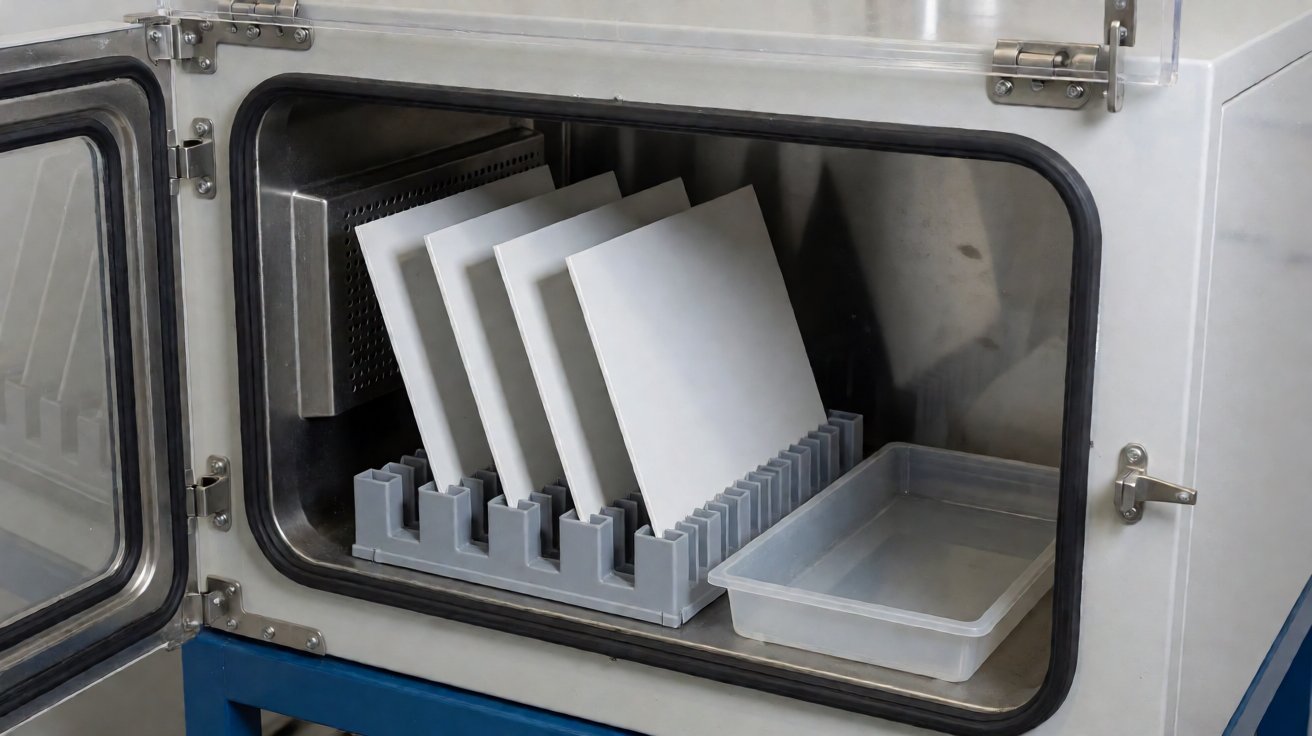
Figure 7: Salt spray corrosion testing of scribed powder coated steel panels in a test cabinet.
Powder Coating Programmes We Have Delivered
Case 1: Enclosure Builder – Cabinet Range in One Colour
An enclosure builder used a powder coating service for wall-mount and floor-standing cabinets coated in a single satin grey, with earth studs and gland apertures masked: batches of 50-300 pieces, three to six times a year, a minimum of 20-50 pieces and FOB prices in the $15-80 range per piece including coating.
The programme was won on colour consistency across a cabinet and its door rather than on price per part. Powder lots are held for the programme, the first batch shipped 15-30 days after approval, and annual spend sat in the $30k-60k band with third-party inspection before shipment.
Case 2: Equipment OEM – Brackets and Covers, Multiple Colours
An equipment OEM ordered brackets, cover plates and small panels from a powder coating service in four colours to match product families: batches of 200-800 pieces, four to eight batches a year, a minimum of 100 pieces and FOB prices from $2 to $15 each depending on size and colour.
This programme lived on colour change discipline and on masking small threaded features. Parts are grouped by colour to minimise changeovers, masking is jigged, and a 4-6% step-down was agreed on repeated parts in the second year. Annual spend stayed in the $15k-40k band.
Case 3: Infrastructure Supplier – Outdoor Cabinets, Corrosion Grade
An infrastructure supplier ordered roadside cabinets and mounting frames with a powder coating service with a corrosion-grade specification: batches of 10-40 pieces, two to four batches a year, a minimum of 5-10 pieces and FOB prices between $100 and $400 per cabinet including coating and packing.
The requirement was corrosion life, so pretreatment, thickness and salt spray evidence all mattered more than appearance. Test panels run through the line with each batch, the first batch shipped 20-35 days after approval, and annual spend landed in the $25k-70k band.
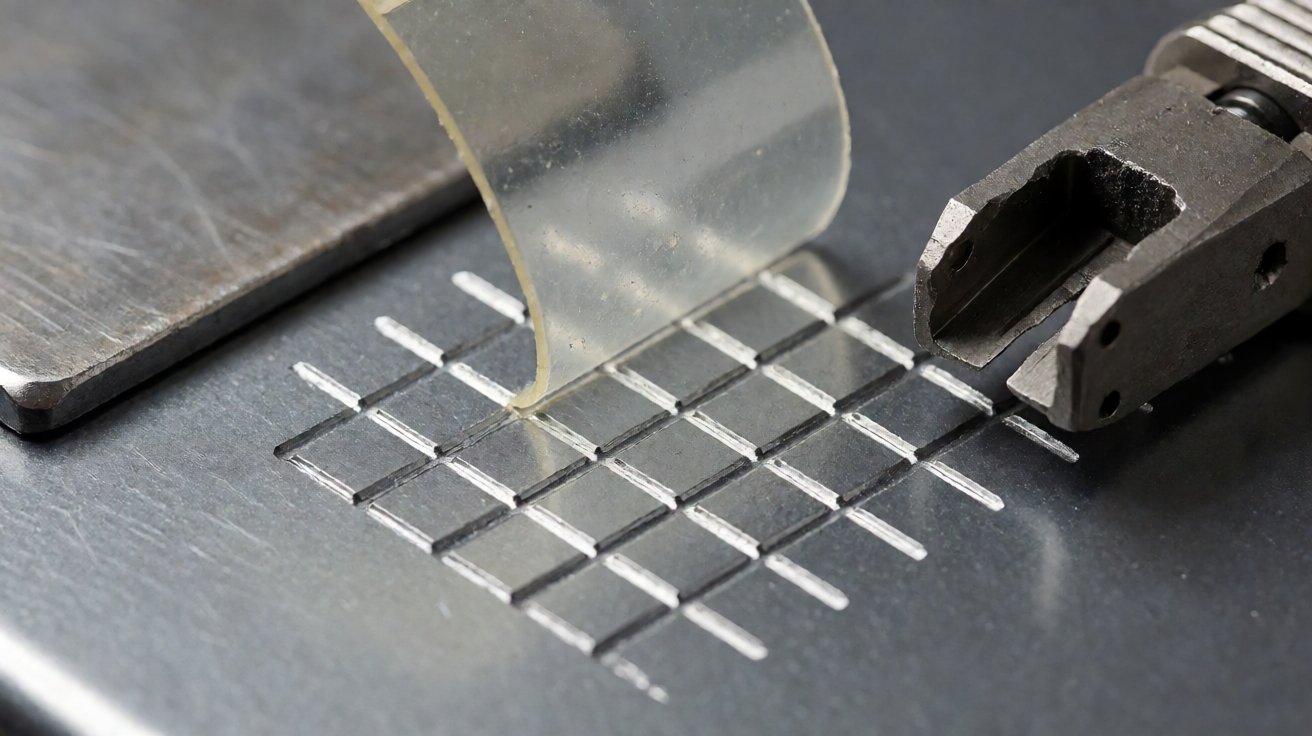
Figure 8: Cross-hatch adhesion test on a powder coated panel with adhesive tape being peeled back.
Summary and Next Steps
How to Specify a Powder Coating Service
Specify a powder coating service from the environment backwards. Fix the substrate and pretreatment, the colour reference and gloss, the target film thickness, and the surfaces that stay bare. Masking, packing and test evidence follow from those four answers.
Then ask two things: how pretreatment is controlled, and where thickness is measured. Those answers separate a service that coats from one that finishes to a specification.
Why XHX Metal
XHX Metal keeps laser cutting, CNC punching, forming, welding, grinding, coating and assembly in one 2,000 sqm factory in Dongguan: two 6 kW fiber laser cutting machines at +-0.01 mm positioning accuracy, CNC turret punching, CNC bending, TIG and MIG welding and coating partners, at about 500,000 parts a year.
The factory holds ISO 9001:2015 and CE, works with SGS on inspection, and has supplied OEM and brand customers in North America and Europe for over a decade. Supplier-qualification support is described by NIST MEP.
How to Start Your Programme
Send a drawing or sample with substrate, colour reference, gloss, thickness and masking requirements for a quotation with the lead time. The coating process is described on the powder coating capability page, related finishing on the grinding and finishing page, materials on the stainless steel and aluminium material pages, and projects start from the contact page; enquiries also reach sales01@xinghaoxin.com.
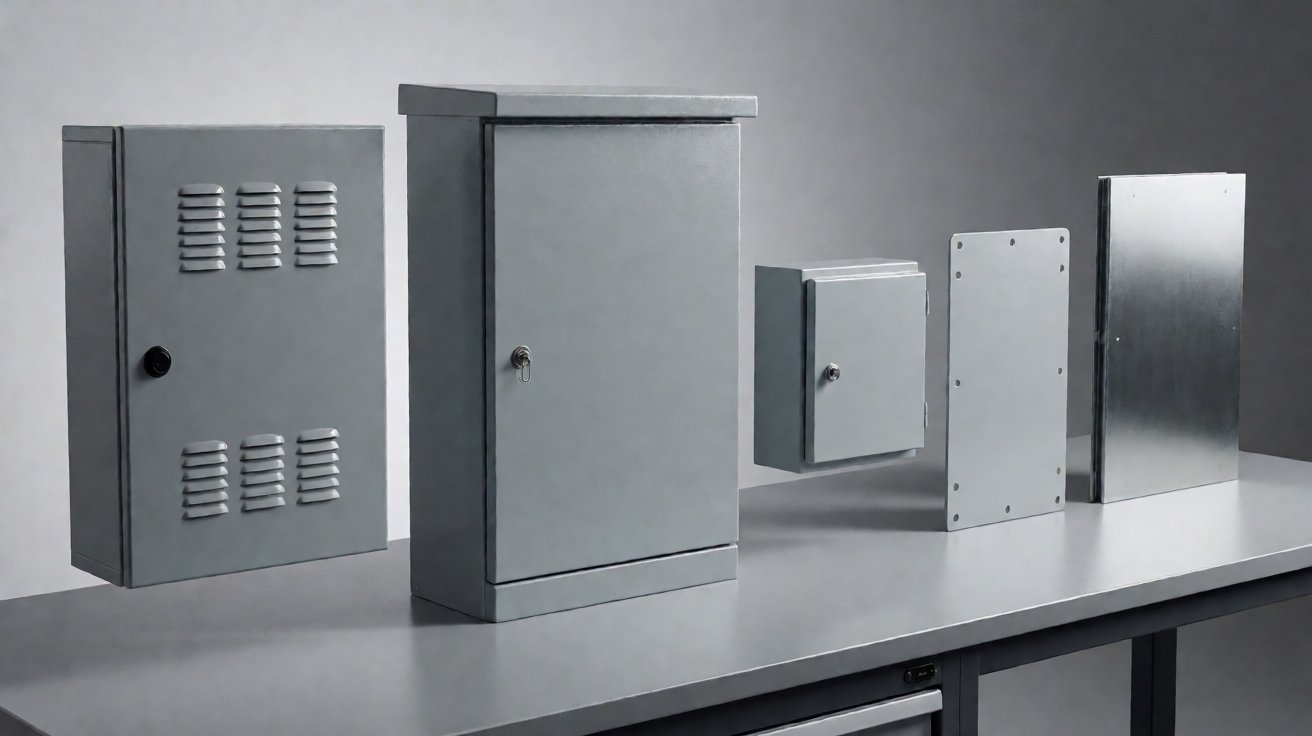
Figure 9: Finished powder coated enclosures: wall cabinet, floor cabinet, junction box and mounting plate.
FAQ: Powder Coating Service
What is the minimum order? Around 100 pieces for small parts and 20-50 pieces for larger panels; single samples and colour trials are quoted too.
Can you coat parts we manufacture elsewhere? Yes. Customer-supplied parts are coated to the same specification, provided the substrate and its condition are known before pretreatment.
How thick is the coating? Typically 60 to 80 microns for enclosure work, and 100 microns or more where a corrosion specification applies; thickness is confirmed at defined points on the part.
Can threads and mating faces stay bare? Yes. Threaded holes, earth studs, shielding lands and mating faces are masked with silicone plugs or high-temperature tape, agreed on the drawing before the batch is coated.
Do you coat both steel and aluminium? Yes, but the pretreatment differs: steel is phosphated or conversion coated, while aluminium needs its own conversion treatment before the powder will bond reliably.